

Tieguanyin (say "tyeh-gwan-yin") is a rolled oolong from Anxi county in Fujian, China. The leaves are partly oxidized, then rolled into tight little balls that unfurl over many steeps. It smells like orchids, tastes buttery and sweet rather than grassy or malty, and it's the tea most people in China mean when they say "oolong."
The short version
- Tieguanyin (铁观音) means "Iron Goddess of Mercy." "Tie guan yin" and "tieguanyin" are the same tea, just spelled differently.
- It's an oolong, not a green tea, even though the modern light-roast style looks green enough to fool you.
- Two legitimate styles: light roast (floral, fresh, bright) and traditional roast (toasty, rounder, keeps better). Neither is fake.
- The leaves come rolled into balls. Good leaf gives you six to eight steeps, and the taste changes every round.
- Brew it hot and with plenty of leaf. Timid brewing is what makes oolong taste like nothing.
In this post
What Tieguanyin actually is
Oolong sits between green tea and black tea. Green tea is stopped before it oxidizes. Black tea is taken all the way. Oolong is halted somewhere in the middle, and that middle is wide: a light Tieguanyin might be oxidized roughly 20 percent, a heavier traditional one closer to 40.
What makes Tieguanyin recognizable on sight is the shape. After oxidation the leaves are wrapped in cloth and rolled, again and again, until each one is a dense little pellet. That's why the dry leaf looks like green gravel and weighs more than you expect. Drop the pellets in hot water and they slowly open into whole, thick, glossy leaves, some still joined to a stem. Half the pleasure of this tea is watching that happen.
It belongs to the same family covered in our guide to oolong tea, but Tieguanyin is the one that made the category famous.
Where the name comes from
Guanyin is the bodhisattva of compassion, a figure you'll find in temples all over China. Tieguanyin is named after her, which tells you something about how the tea was regarded.
The story usually goes like this. A poor farmer in Anxi walked past a neglected temple to Guanyin every day and, having nothing to give, swept it clean and lit incense. She appeared to him in a dream and told him to look behind the temple, where he found a single tea shoot. He planted it, and the tea it gave was better than anything around. As for "iron," the common explanation is that the finished leaves are unusually dense and heavy for their size.
There's a competing version involving a scholar and an emperor, which is generally how these things go in Chinese tea. Treat both as folklore rather than history. The encyclopedia entry lays out both if you want them.
Anxi, Fujian: where it grows
Tieguanyin comes from Anxi, a county of hills and terraced gardens in southern Fujian. The cultivar is grown elsewhere now, including Taiwan and other parts of China, but Anxi is the home ground and the reference point everyone else is measured against.

Half my family is from Fujian, and Tieguanyin was the default at the table growing up in Hong Kong. Not the good stuff, mostly. After a heavy dinner someone would refill the pot three or four times with whatever tin was in the cupboard, and nobody thought of it as an occasion. That's the thing people miss about this tea when they meet it in a shop with a price tag on it: at home it's an everyday drink, poured out fast and drunk hot while people argue over the last of the fish.
Light roast vs. traditional roast
This trips up more people than anything else about Tieguanyin. Buy two bags from two sellers and they can look and taste like different teas. They usually are, in a sense: they're different processing styles of the same leaf.
The modern style, qingxiang (清香, "fresh aroma"), is lightly oxidized and barely roasted. It's jade green, intensely floral, and it took over the market from roughly the 1990s onward because that aroma sells itself across a shop counter. The older style, nongxiang (浓香, "strong aroma"), is roasted properly over charcoal or in an oven, which darkens the leaf and trades some of the perfume for depth.
| Light roast (qingxiang) | Traditional roast (nongxiang) | |
|---|---|---|
| Dry leaf | Jade green, tight pellets | Dark green-brown to chestnut |
| Aroma | Orchid, lilac, fresh cream | Toasted grain, stone fruit, a little caramel |
| Liquor | Pale gold-green | Deep gold to amber |
| In the mouth | Bright, floral, buttery, sweet finish | Rounder and warmer, less perfume, longer finish |
| Water | 90–95°C / 194–203°F | 95–100°C / 203–212°F |
| Keeping | Drink it fresh; keep it cool and sealed | Keeps far better, and some people age it on purpose |
My honest opinion, for what it's worth: the light style is easier to fall in love with and the roasted style is easier to live with. The floral one is thrilling for a month and then you notice it's a bit thin. The roasted one never dazzles you and never disappoints you either. Start light, and try a roasted one before you decide what you think of Tieguanyin. And if the roasted style turns out to be the one you want more of, the road leads north to Wuyi and Da Hong Pao, where the charcoal is the whole point.
Our Tie Guan Yin is the rolled Anxi style, and like every tea we ship it's screened by an independent lab for pesticides and heavy metals before it goes anywhere near a box.

What Tieguanyin tastes like
Orchid is the word everyone reaches for, and it's the right one. There's a high floral note in the aroma that's closer to a flower shop than to a garden, and it hits you before you drink anything, when you lift the hot lid off the leaves.
In the mouth a good light-roast Tieguanyin is smooth and slightly thick, with a buttery quality people sometimes call milky, though nothing has been added to it. It finishes sweet, and the sweetness keeps going after you swallow. The Chinese term for that returning sweetness is huigan. Once you notice it, you start looking for it in every tea.
What it is not: grassy, or astringent, or malty. If your Tieguanyin tastes green and sharp like a bad green tea, the water was probably too hot for a light-roast leaf, or the tea has gone stale. If it tastes flat and dusty with a burnt edge, that's a roast covering up mediocre leaf, which is what cheap Tieguanyin usually is.
How to brew Tieguanyin
Two rules matter more than the numbers. Use more leaf than feels reasonable, and use properly hot water. Rolled oolong is dense, so a spoonful is less tea than it looks, and unlike green tea it doesn't scorch easily. Underleafing and lukewarm water are why so many people conclude oolong is boring.
| Method | Leaf | Water | First steep |
|---|---|---|---|
| Gaiwan, ~110 ml | 5–7 g | 95°C / 203°F | 15–20 sec, then add 5–10 sec each round |
| Small teapot, ~150 ml | 7 g | 95°C / 203°F | 20 sec |
| Mug with a strainer, ~250 ml | 3–4 g | 90–95°C / 194–203°F | 2–3 min, then refill twice |
| Cold brew, 500 ml bottle | 5 g | Cold, in the fridge | 6–8 hours (plan ahead) |
A quick rinse helps: pour hot water over the pellets, count to three, throw that water out. It isn't about washing the tea. It's about warming the leaves so they start to open, which makes the first real steep much better. If you want the full method, our guide to using a gaiwan covers the grip and the pour, and the loose leaf brewing guide covers every other vessel you might own.
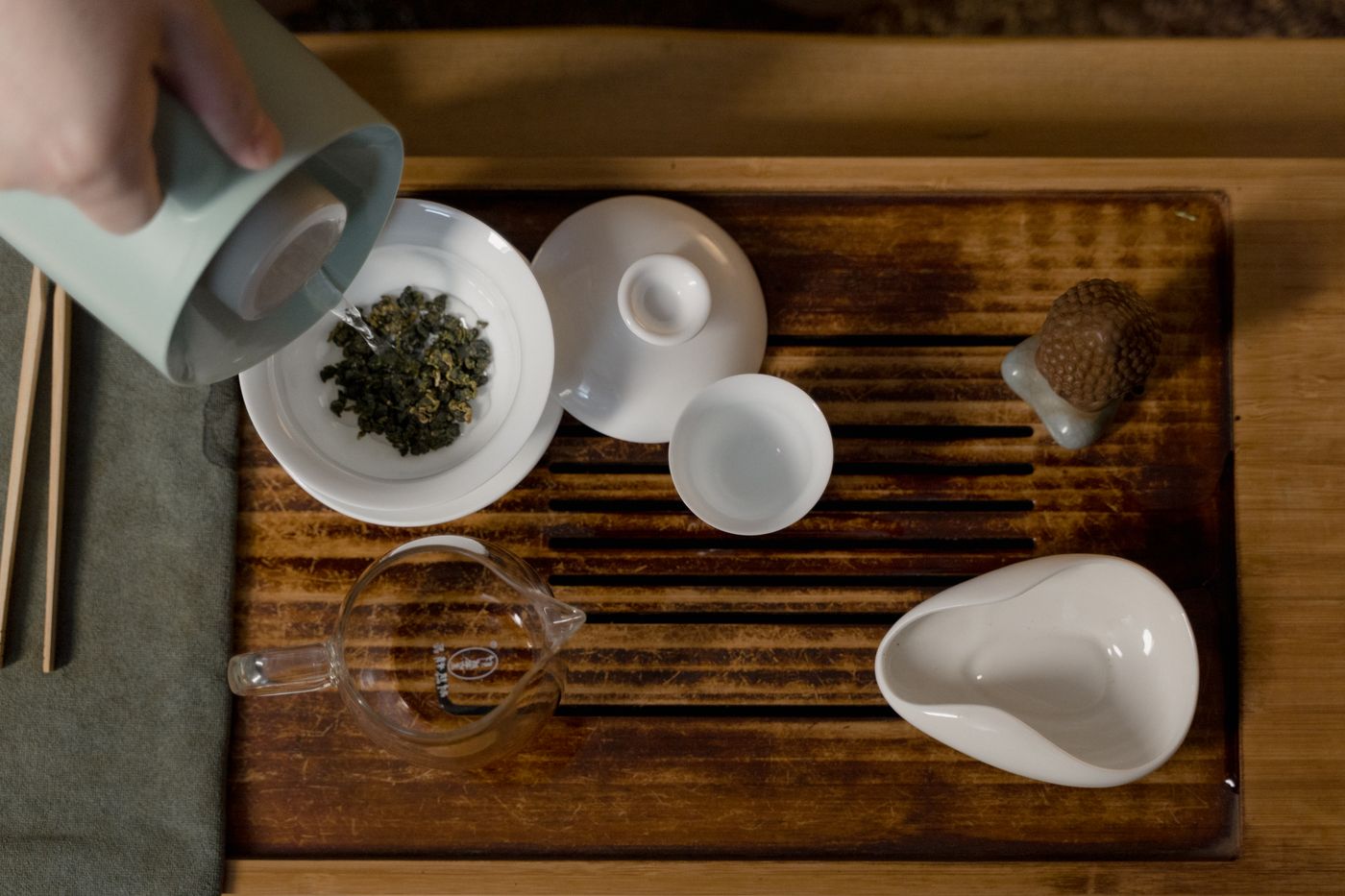
How many steeps you get
With gongfu-style brewing, expect six to eight from decent leaf, and I've had ten from very good leaf. This is where the value argument for whole-leaf tea actually lives. Five grams of Tieguanyin brewed this way makes well over a liter of tea across a session, and no two cups taste the same.
The shape of a session, roughly: the first steep is thin and mostly aroma, since the pellets have barely opened. Two through four are the peak, floral and sweet and full. By five or six the flower fades and something softer and greener comes up behind it. When the sweet finish stops returning, you're done. Stretch the last few steeps longer, up to a minute or more, and stop when it tastes like warm water.
One good habit: pour every drop out each time. Leaves sitting in leftover water keep brewing and turn bitter, and that's the mistake that ruins steep number three.
FAQ
What does Tieguanyin taste like?
Floral and buttery, with a sweetness that lingers after you swallow. The classic descriptor is orchid. Light-roast versions taste bright and fresh; traditionally roasted ones taste toastier and rounder, more like stone fruit and grain. Neither should taste grassy or harsh.
Is Tieguanyin a green tea or an oolong?
An oolong. The confusion is fair, because modern light-roast Tieguanyin is only lightly oxidized and the leaves stay green. But it's partly oxidized and rolled, which puts it firmly in the oolong family, between green and black tea.
How much caffeine is in Tieguanyin?
Oolong typically runs around 30 to 50 mg of caffeine per 8 oz cup, less than a comparable cup of coffee. The exact amount shifts with leaf quantity, water temperature and steep time. The Mayo Clinic caffeine chart is a useful reference for comparisons.
How many times can you steep Tieguanyin?
Six to eight steeps with gongfu-style brewing, where you use a lot of leaf and short infusions. In a big western mug you'll get two or three refills. Add time to each successive steep, and stop when the sweet aftertaste stops coming back.
Is there a difference between Tieguanyin and Tie Guan Yin?
No. They're two ways of writing the same three Chinese syllables, 铁观音. You'll also see Ti Kuan Yin, Iron Goddess, and Iron Buddha on labels. All the same tea, though quality between sellers varies enormously.
If you want to taste the difference between an oolong, a green and a black tea side by side, this Tie Guan Yin sits alongside the rest of our loose leaf collection.