

To brew loose leaf tea, put about a teaspoon of leaves in your cup, pour over water at the right temperature for that tea, and let it steep a few minutes before straining. Most teas want 2 to 3 grams of leaf per 8-ounce cup, water somewhere between 75°C and 100°C depending on the type, and 2 to 4 minutes in the water. You don't need special gear to start, and once you have the ratio in your head you can do it half-asleep.
The short version
- One teaspoon (roughly 2–3g) of loose leaf per 8-ounce cup is the safe starting point.
- Green and white teas like cooler water (75–85°C); black tea and pu-erh want it close to boiling.
- No infuser? A mug and a small strainer work fine. Or skip both and drink it grandpa style.
- Bitter tea almost always means the water was too hot or the leaves sat too long, not that the tea is bad.
- Decent loose leaf can be rebrewed two, three, sometimes five or more times.
In this post
The method that always works
Here is the version I give friends who have never brewed loose tea before. It needs a mug and a small strainer, nothing else.
Put a teaspoon of leaves straight into the mug. Heat your water and let it cool for a moment if you're making something delicate like green tea. Pour the water over the leaves, filling the mug. Wait a few minutes while the leaves sink and open. Then set the strainer over a second cup and pour the tea through it, leaving the wet leaves behind.
That's it. The leaves steep loose in the water, which is exactly what you want, because cramped leaves in a tiny metal ball never get room to unfurl and give you their flavour. When you brew loose and strain at the end, even a cheap tea tastes better than it has any right to.
How much loose leaf tea per cup
The honest answer is that it depends on the leaf, but a teaspoon per cup gets you close every time. Rolled teas like oolong or a tight green look like almost nothing dry and then swell to fill the pot, so a level teaspoon is plenty. Fluffy, open leaves like white tea or a big-leaf black take up more space dry, so you can be a little generous. If you'd rather weigh in grams than guess with spoons, I keep every tea's numbers in one place in our tea-to-water ratio cheat sheet.
| Vessel | Water | Loose leaf |
|---|---|---|
| Teacup | 8 oz / 240 ml | 1 tsp (~2–3 g) |
| Large mug | 12 oz / 350 ml | 1.5 tsp (~3–4 g) |
| Small teapot | 16 oz / 475 ml | 2 tsp (~5–6 g) |
| Gaiwan (gongfu style) | 4 oz / 120 ml | 1 heaped tsp (~5 g) |
Notice the gaiwan row. Same small amount of water, much more leaf. That's the whole trick behind Chinese-style brewing: a lot of leaf, a little water, and short steeps you pour off fast. More on that below.

Every method, ranked by fuss
There is no single correct way to brew loose tea. There's just more fuss or less. Here they are from laziest to most involved.
Grandpa style. Leaves go straight in a glass or mug, hot water on top, and you drink around them once they sink. You top up with more water as you go. This is how tea actually gets drunk across most of China, in offices and on trains, and it works beautifully for greens and light oolongs. The leaves keep steeping, so use a bit less and don't let it stew.
Mug and strainer. The method from the top of this post. Loose steep, strain at the end. The best balance of easy and good.
Teapot. A small pot with a built-in filter or a basket infuser lets you brew a couple of cups and pour off cleanly. Fill the basket loosely so the leaves can move — and if you are shopping for a separate one, be warned that most loose leaf tea infusers are too small to brew properly.
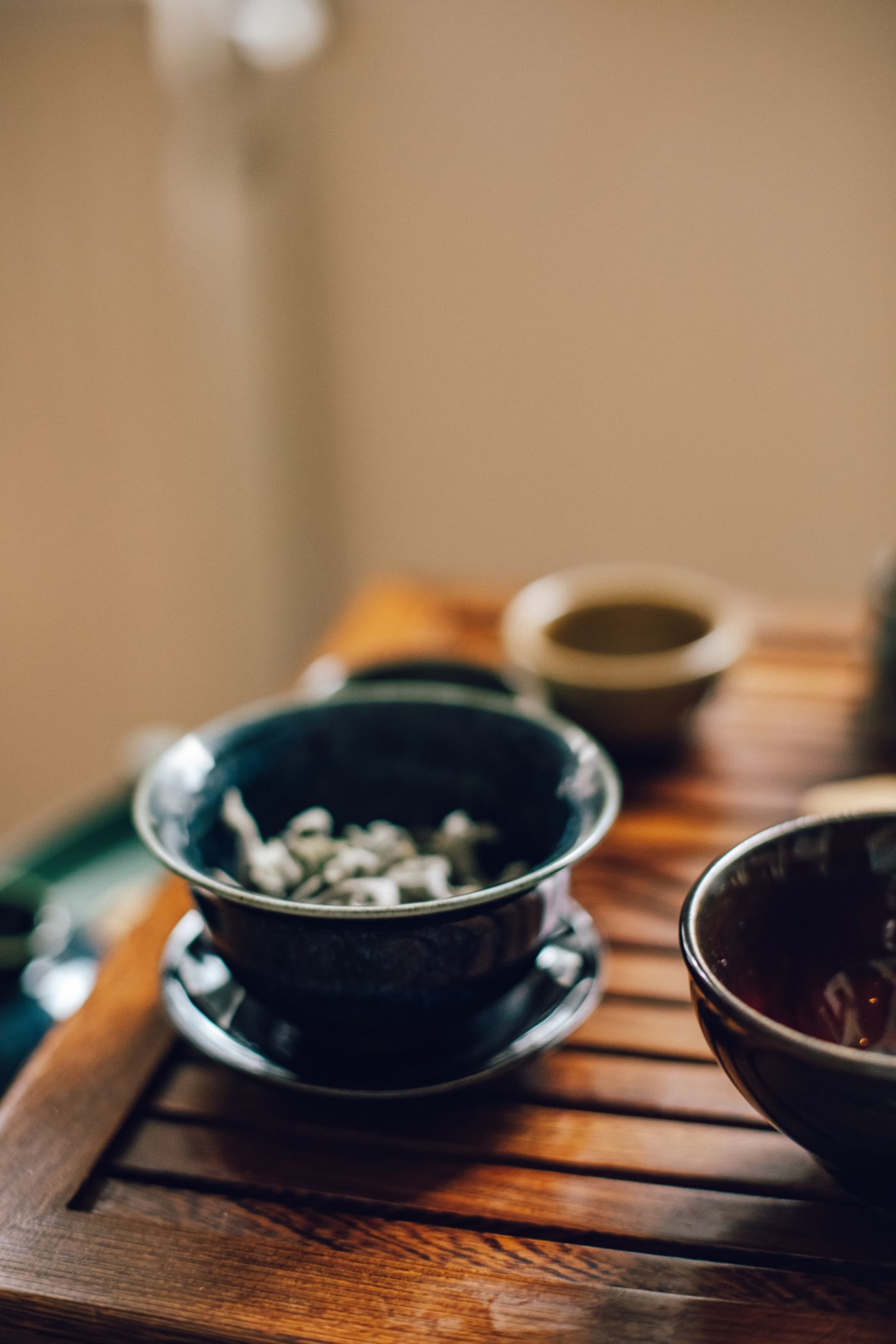
Gaiwan. A lidded bowl, the classic Chinese brewing vessel. You pack in more leaf, use less water, and steep for seconds rather than minutes, pouring off each round through the tilted lid. It sounds fiddly and takes ten minutes to get the hang of, but it's the way to taste a good tea properly, and it lets you get five or more brews out of the same leaves. If you want to go all the way down this path, I wrote a full guide to gongfu tea.
Cold brew. The least effort of all, if you can wait. Put loose leaf in a bottle of cold water, roughly a gram of leaf per 100 ml, and leave it in the fridge for six to eight hours. You get a smooth, sweet, low-bitterness brew with almost no work. The catch is the wait, so start it the night before.

The only brewing chart you need
Temperature and time matter more than most people think, and they're the difference between a tea that sings and one that turns harsh. These are working ranges, not laws. Treat the low end as your default and adjust to taste.
| Tea type | Water temp | Steep (Western) | Re-steeps |
|---|---|---|---|
| Green | 75–85°C (170–185°F) | 1–3 min | 2–3 |
| White | 80–90°C (175–195°F) | 2–5 min | 3–4 |
| Oolong | 90–95°C (195–205°F) | 2–4 min | 4–6 |
| Black | 90–100°C (195–212°F) | 3–5 min | 2–3 |
| Pu-erh (rinse first) | 95–100°C (205–212°F) | 2–4 min | 5+ |
| Jasmine / scented green | 80–85°C (175–185°F) | 2–3 min | 2–3 |
No thermometer? You don't need one. Water off the boil, left to sit for two or three minutes, lands around 80°C, which is right for greens. Straight off a fresh boil is right for black tea and pu-erh. If you want the physics behind steeping and why hotter water pulls out more tannin and bitterness, the overview on tea preparation is a solid primer.
I should admit something here. I grew up watching my grandfather brew grandpa style out of an old glass jar, no strainer, no timer, refilling it all afternoon, and it was some of the best tea I've had. So when people ask me for the "correct" method, I tell them the correct method is the one you'll actually use every day. Precision is for when you've found a tea worth being precise about. Start loose and easy, and let the fussier methods earn their place.
Why is my tea bitter, and other fixes
Almost every brewing problem is one of three things: too hot, too long, or too much leaf. Bitter and astringent usually means the water was near boiling on a delicate green, or the leaves sat past their welcome. Drop the temperature, shorten the steep, and it comes right.
Weak and watery is the opposite: not enough leaf, or water that had gone cold. Add a little more leaf before you add more time, because over-steeping to chase strength just brings back the bitterness. And if the leaves float and won't sink, they're usually just dry and buoyant. Give them a minute, they'll drop.
Store the rest of the bag well and these problems get rarer, because stale leaf brews flat and muddy. A quick read of how to store loose leaf tea will keep what you buy tasting the way it did on day one.
FAQ
How much loose leaf tea per cup?
About one teaspoon, or roughly 2 to 3 grams, per 8-ounce cup. Use a level teaspoon for dense rolled teas like oolong and a slightly heaped one for fluffy, open leaves like white tea. When in doubt, start with less; you can always steep a second cup from the same leaves.
Can you rebrew loose leaf tea?
Yes, and you should. Good loose leaf gives two to three brews at a minimum, and oolong or pu-erh will go five or more, often tasting different each round. Just brew the next round a touch longer. We go deeper in our guide on reusing tea leaves.
Do you need an infuser for loose leaf tea?
No. A small strainer over a second cup does the same job, and grandpa style needs nothing at all beyond a glass. An infuser or a pot with a basket is convenient, not essential. Whatever you use, give the leaves room to move; cramped leaves brew weakly.
Why is my loose leaf tea bitter?
Usually the water was too hot or the tea steeped too long, sometimes both. Delicate greens turn harsh near boiling. Cool the water, cut the steep time, and use a touch less leaf. Bitterness is almost always a brewing setting, not a fault in the tea itself.
Can you brew loose leaf tea in a regular teapot?
Absolutely. Add the leaves loose, pour in the water, and strain into cups when it's ready, or use a basket infuser if your pot has one. Fill the basket loosely so the leaves can open. It's one of the easiest ways to brew for two or three people at once.
New to brewing loose and not sure where to start? Our loose leaf collection covers every style in this guide — green, oolong, black, white and pu-erh — so you can pick one and work through the methods above.