

Moonlight White (月光白, Yue Guang Bai) is a white tea from Yunnan, made from the same big-leaf tea plants that give us pu-erh, and withered indoors instead of out in the sun. That withering is why the dry leaf comes out two-toned: nearly black on one face, silver-pale on the other. It tastes of honey, dried hay and soft stone fruit, and it rounds out with age.
The short version
- It is a white tea, even though it is made from the pu-erh tea plant. Processing decides the category, not the bush.
- The two-tone leaf is normal, not a defect. One face dark, one face downy silver.
- The "withered under the moon" name is poetry with a grain of truth: withering happens indoors, away from the sun, and often runs overnight.
- Taste: honey, hay, apricot, a creamy body. Softer than a Fujian white, sweeter than a young raw pu-erh.
- Brew hot but not boiling, around 85–90°C, and use more leaf than feels sensible.
- It ages. Kept dry and dark, the honey deepens and the edges soften.
In this post
What is Moonlight White tea?
Moonlight White is Yunnan's answer to white tea. Most white tea you meet comes from Fujian, from small-leaf bushes bred over centuries for fat, downy buds. Moonlight White comes instead from Yunnan's big-leaf tea plants, the broad-leaved variety that also gives us sheng and shou pu-erh. Same raw material, completely different destination.
The processing is minimal, which is what makes it white tea: pick, wither, dry. No pan-firing to kill the enzymes like a green tea. No rolling and oxidising like a black tea. The leaf is simply allowed to lose its water slowly and change as it goes.
Most of the style comes out of Jinggu and the wider Pu'er and Lincang tea belt, up in the hills of southern Yunnan. China's traditional tea processing techniques, white tea among the six categories, were inscribed on UNESCO's intangible cultural heritage list in 2022. Moonlight White is a young member of a very old family: as a named tea it is a recent invention, a few decades old at most, not an ancient tribute tea. Anyone who tells you otherwise is selling.
Why the leaves are two different colours
Open a bag and you will see something that looks like a mistake. Half the leaves are dark, nearly black. The other half are pale and furred with white down. People email me about this.
It is one leaf, not two teas. The underside of a tea leaf carries fine white hairs. The top side does not. When the leaf withers flat and slowly in still air, out of direct sun, the top darkens as it oxidises a little and the downy underside stays pale. The result is a leaf that reads black-and-silver depending on which way it fell. Pick one up and turn it over.
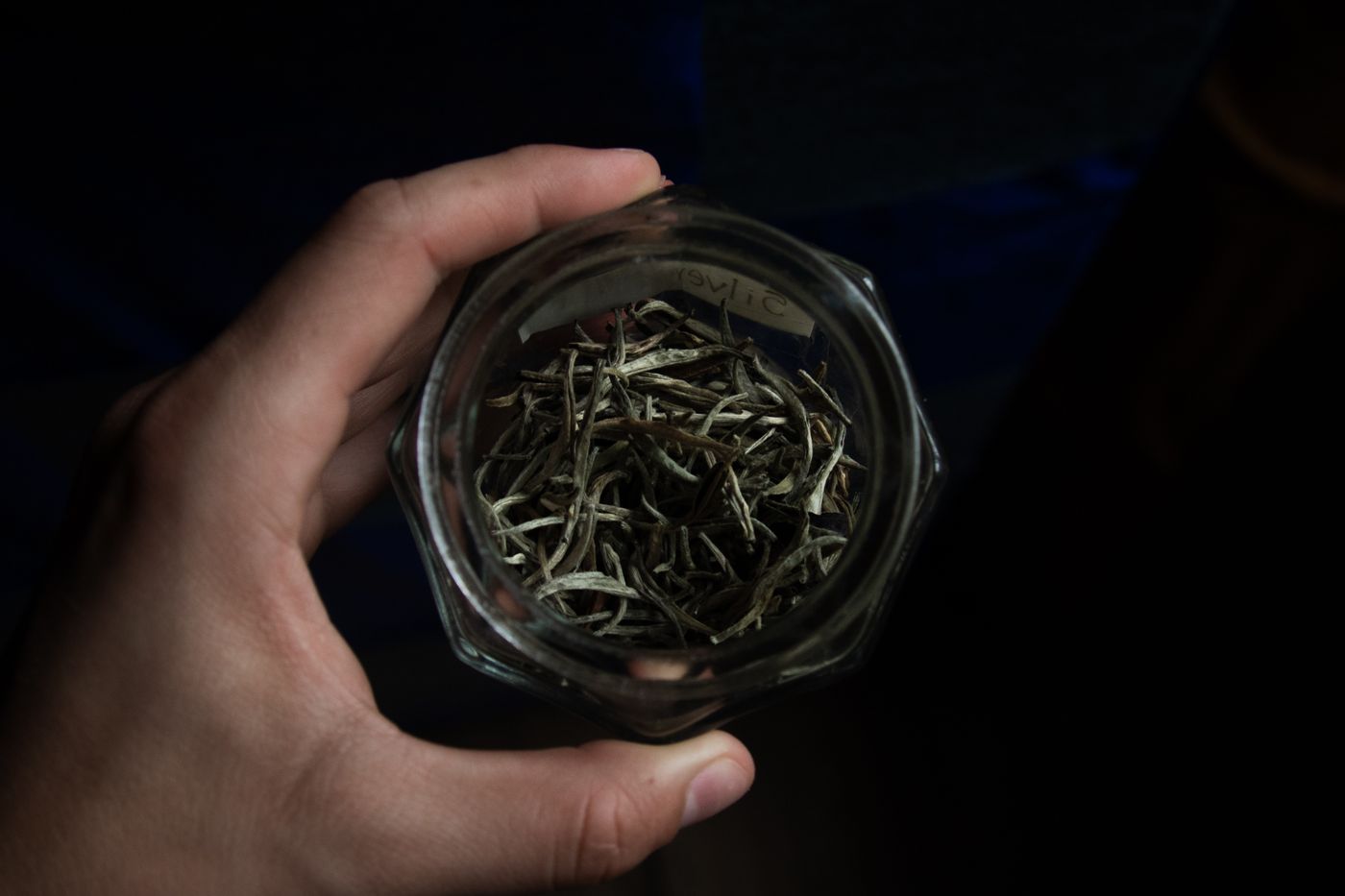
The first time someone handed me a bag of it, I assumed I had been sold a mixed lot: half black, half pale, like two teas shuffled together in the wrong sack. I have since stopped apologising for how it looks and started leading with it. It is the most immediately recognisable dry leaf we carry.
Is it really withered under moonlight?
The name says the leaves are withered at night, under the moon, never touching sunlight. It is a lovely story and I am fond of it. It is also mostly marketing.
Here is the part that is true. Moonlight White really is withered away from direct sun, indoors, on racks or bamboo trays, over a long slow spell that often runs through the night because Yunnan spring days are hot and the shed is cooler after dark. Shade-withering rather than sun-withering is a genuine and deliberate choice, and it is the reason the tea comes out creamy and dark-edged instead of bright and grassy.
Here is the part that is not. Moonlight itself does nothing. There is no chemistry in reflected sunlight at that intensity that changes a tea leaf. The tea is not spread out on a hillside under a full moon while someone plays a flute. It is on a rack, in a building, in the dark, for a day or two.
I would rather you knew that and still liked the tea. The name describes a real technique badly and a real result well.
What does Moonlight White taste like?
Honey and hay first, then fruit. The body is unusually creamy for a tea this lightly processed, and the finish is sweet without being sugary. If you have had a Fujian white and found it too faint to bother with, this is the one that changes your mind. Big-leaf material carries more weight.
| Where | What you get |
|---|---|
| Dry leaf aroma | Dried hay, a little cocoa, faint dried apricot |
| Liquor colour | Pale gold, deepening to light amber over steeps |
| First two steeps | Honey, melon, soft floral top note |
| Middle steeps | Maple sap sweetness, hay, a woody base coming through |
| Late steeps | Thin but still sweet; the hay outlasts everything else |
| Mouthfeel | Creamy, faintly slippery, low astringency |
| Aftertaste | Cooling and sweet, sits at the back of the throat |
What it is not: smoky, bitter, or grassy. If yours tastes sharp and green, the water was too hot or the leaf was rushed at the withering stage.

Moonlight White vs. Fujian white teas
Both are white teas. They taste like cousins, not siblings. The difference is the plant and the sun.
| Moonlight White | Fujian whites (Silver Needle, White Peony) | |
|---|---|---|
| Origin | Yunnan, mostly the Jinggu and Pu'er hills | Fujian, chiefly Fuding and Zhenghe |
| Tea plant | Big-leaf Yunnan variety, the pu-erh plant | Small-leaf bush cultivars bred for buds |
| Withering | Indoors, shaded, often overnight | Frequently sun-withered outdoors |
| Dry leaf | Long, two-tone, black-and-silver | Pale silver-green, uniform, bud-heavy |
| Flavour | Honey, hay, apricot, creamy weight | Delicate, melon, cucumber, light florals |
| Ages well? | Yes, and noticeably | Yes, particularly Fuding whites |
My honest opinion: Silver Needle is the more refined tea and Moonlight White is the more enjoyable one. Silver Needle asks you to pay attention. Moonlight White just gives you honey. There is a fuller picture of the whole category in our complete guide to white tea.
Does Moonlight White have caffeine?
Yes. All tea from the tea plant has caffeine, and I am not going to give you a precise number for this one, because I do not have a lab figure for it that I would trust enough to print.
What I will tell you is that "white tea means low caffeine" is a myth worth dropping. Caffeine concentrates in the young bud, and bud-heavy white teas can carry as much as plenty of black teas. Moonlight White is made from big-leaf material with a good proportion of buds, so treat it as a normal caffeinated tea rather than a bedtime drink. If you want a reference point for daily intake, the FDA's guidance on caffeine is the plainest one I know.
How to brew Moonlight White
The two mistakes are boiling water and not enough leaf. Big withered leaves are bulky, so a spoonful weighs less than you think, and a thin Moonlight White is a sad thing.
| Method | Leaf | Water | Temp | Time | Resteeps |
|---|---|---|---|---|---|
| Mug or teapot | 3–4 g | 250 ml | 85–90°C / 185–195°F | 2–3 min | 2–3, add 1 min each |
| Gaiwan (gongfu) | 5 g | 100 ml | 90°C / 195°F | 15 s, then +5 s | 8–10 |
| Grandpa style | 3 g | 400 ml glass | 85°C / 185°F | Sip and top up | All afternoon |
| Cold brew | 8 g | 1 L | Fridge cold | 6–8 hours | One good batch |

Cold brew is the sleeper here. The honey survives the cold and the hay note recedes, which gives you something close to a very light iced apple tea. If you want the general rules rather than this one tea's, we have a full walkthrough on how to brew loose leaf tea.
Does Moonlight White age?
It does, and this is the part most people miss. White tea is one of the two Chinese categories that improves in storage rather than fading, the other being pu-erh, and Moonlight White inherits some of that habit from its big-leaf parentage.
Over a few years the hay note settles down, the honey turns denser and more like dried fruit, and the whole thing loses whatever green edge it started with. Some producers press it into cakes for exactly this reason. Keep it somewhere dry, dark, at room temperature, and away from anything with a smell, and leave it alone. No fridge, no freezer, no clip-lock bag that has previously held coffee. Our notes on how to store loose leaf tea cover the rest.
The honest trade-off: aged Moonlight White is a different pleasure, not a better one. If you like the fresh honey-and-melon version, drink it now. Nobody hands you a medal for waiting.
FAQ
Is Moonlight White a white tea or a pu-erh?
It is a white tea. The confusion comes from the plant: Moonlight White is made from Yunnan's big-leaf variety, the same one used for pu-erh. But it is withered and dried rather than fixed and piled, and processing is what decides a tea's category.
Does Moonlight White tea have caffeine?
Yes. Every tea from the tea plant contains caffeine, and white teas are not automatically low in it, because caffeine concentrates in the young buds. Treat Moonlight White as an ordinary caffeinated tea and drink it earlier in the day if caffeine affects your sleep.
What does Moonlight White taste like?
Honey and dried hay first, then apricot or melon, over a creamy body with very little astringency. The finish is sweet and cooling. It is fuller and rounder than most Fujian white teas, and nothing like the grassy sharpness people expect from lightly processed tea.
Why are the leaves black and white?
Because you are seeing both sides of the same leaf. The underside carries fine white down; the top side darkens slightly during the long indoor withering. Withered flat and slowly, the leaf ends up two-toned. It is a sign of the style, not a fault.
Moonlight White or Silver Needle: which should I try first?
Start with Moonlight White if you want something immediately likeable and sweet. Start with Silver Needle if you enjoy subtle teas and want the classic Fujian benchmark. Moonlight White is the more forgiving of the two to brew, and harder to ruin with slightly-too-hot water.
If you want to taste the two-tone leaf for yourself, our Moonlight White comes from Yunnan and ships the way everything here does: farm-direct, lab-tested, in packaging that composts.