

Lapsang Souchong is a black tea from Tongmu, a village in the Wuyi Mountains of northern Fujian, traditionally dried over smouldering pine so the smoke goes into the leaf. The heavily smoked version sold across the West is an export style. In China the same tea is usually drunk unsmoked, and tastes of dried longan and honey.
The short version
- Lapsang Souchong is the English name for zheng shan xiao zhong, a black tea from Tongmu in the Wuyi Mountains, widely credited as the first black tea.
- The smoke comes from drying the leaf over pine fires in a wooden smokehouse, a practical way to dry tea in a cold, wet valley before it was a flavour.
- Heavily smoked Lapsang is largely made for export. China mostly drinks the unsmoked style, which tastes of dried longan, malt and honey.
- Most tea sold under the name outside China never came from Tongmu, and is smoked far harder than the original.
- It is a food tea. Smoked fish, aged cheddar, barbecue, mushrooms, anything with char on it.
- We don't sell it. If you want a Chinese black tea without the campfire, that is Dianhong.
In this post
What is Lapsang Souchong?
A fully oxidised black tea from Tongmu village in the Wuyi Mountains of northern Fujian. Its Chinese name is zheng shan xiao zhong, 正山小种, and both halves carry information.
Zheng shan means "true mountain", and refers to the protected core area around Tongmu. Tea grown outside that zone is wai shan, "outside mountain", and is not supposed to use the name. Xiao zhong, rendered "souchong" in English, means something like "small sort" and describes the picking standard: larger, more mature leaves further down the shoot rather than the tender buds at the tip. That leaf is tougher and much better suited to being smoked and drunk with food.
The "lapsang" half is less settled. I have seen at least three explanations, most tracing it to a southern dialect word for pine, and I don't think anyone can prove which is right. It is a trade name that reached English through the ports, and trade names get mangled.
One claim here is worth taking seriously: this is generally credited as the first black tea, the origin point for a category that spread to Keemun, to Yunnan, to India and Sri Lanka, and eventually to almost every teabag in Britain. The whole black tea aisle is downstream of a cold valley in Fujian.

Tongmu, and why the smoke started
Tongmu sits high in the Wuyi range, inside a nature reserve, surrounded by pine and bamboo. UNESCO inscribed Mount Wuyi as a World Heritage site in 1999 for its forests and its cultural history. It is steep, damp and cold, and the weather at picking time is unreliable.
That last detail explains more about this tea than the legends do. Sun-drying is what you use when you have sun. In Tongmu you often don't, so the work happens indoors in a qing lou, a wooden smokehouse with a fire pit below and slatted drying floors above. The leaf withers over smouldering pine, gets rolled and oxidised, and is dried over pine again at the end. The smoke is not sprayed on afterwards. It is baked in through the drying, which is why a well-made smoked Lapsang tastes integrated rather than perfumed.
The origin story you will read everywhere: soldiers passing through during a period of unrest camped in a tea shed, the day's harvest sat too long, and the farmers rushed the drying over pine fires to save the batch. The accident sold well and became the style. It is told as fact in a hundred places and documented in none I can find, so treat it as folklore. The unromantic version, that a wet valley forces you to dry tea over fire, is duller and more likely.
Wuyi processing is not a museum piece either. China's traditional tea processing techniques were added to UNESCO's intangible cultural heritage list in 2022, and the Wuyi methods are part of that body of practice.
Smoked vs unsmoked: the split nobody explains
The single most useful thing to know about Lapsang Souchong, and almost no shop tells you: there are two very different products wearing one name.
| Smoked (the export style) | Unsmoked or lightly smoked (the domestic style) | |
|---|---|---|
| Usual Chinese name | yan xun xiao zhong, smoked souchong | zheng shan xiao zhong |
| Dry leaf aroma | Pine tar, bonfire, smoked ham, tarry at the extreme end | Dried longan, malt, honey, a thread of pine resin |
| In the cup | Smoke leads; a good one has sweetness underneath, a bad one is only ash | Sweet and fruity, cooked plum and cocoa, gentle |
| Body | Full and drying | Round and soft, low astringency |
| Who it suits | Peated whisky drinkers, anyone who likes char | Anyone who likes Chinese black tea at all |
| Mostly sold in | Europe and North America | China |
| Brewing | Less leaf, cooler water, shorter steep. It is powerful | Ordinary black tea parameters |
| With milk | Works, if a smoked tea latte appeals | Better without |
Which explains why opinion on this tea is so violently split. Two people arguing about Lapsang Souchong are often drinking two different products and neither knows it.
There is a commercial complication too. A large share of what sells as Lapsang Souchong in the West never came near Tongmu. It is black tea from elsewhere in Fujian, or further afield, smoked hard over pine to hit the profile the export market expects. Not automatically bad tea. Just not the thing the name describes.
Tongmu itself has moved on. Since the mid-2000s, unsmoked styles from the same valley, including a bud-picked tea called Jin Jun Mei, have taken the high end of the domestic market. Its producers are not chasing the smoky export trade any more, which is why that trade increasingly gets supplied elsewhere.
What Lapsang Souchong tastes like
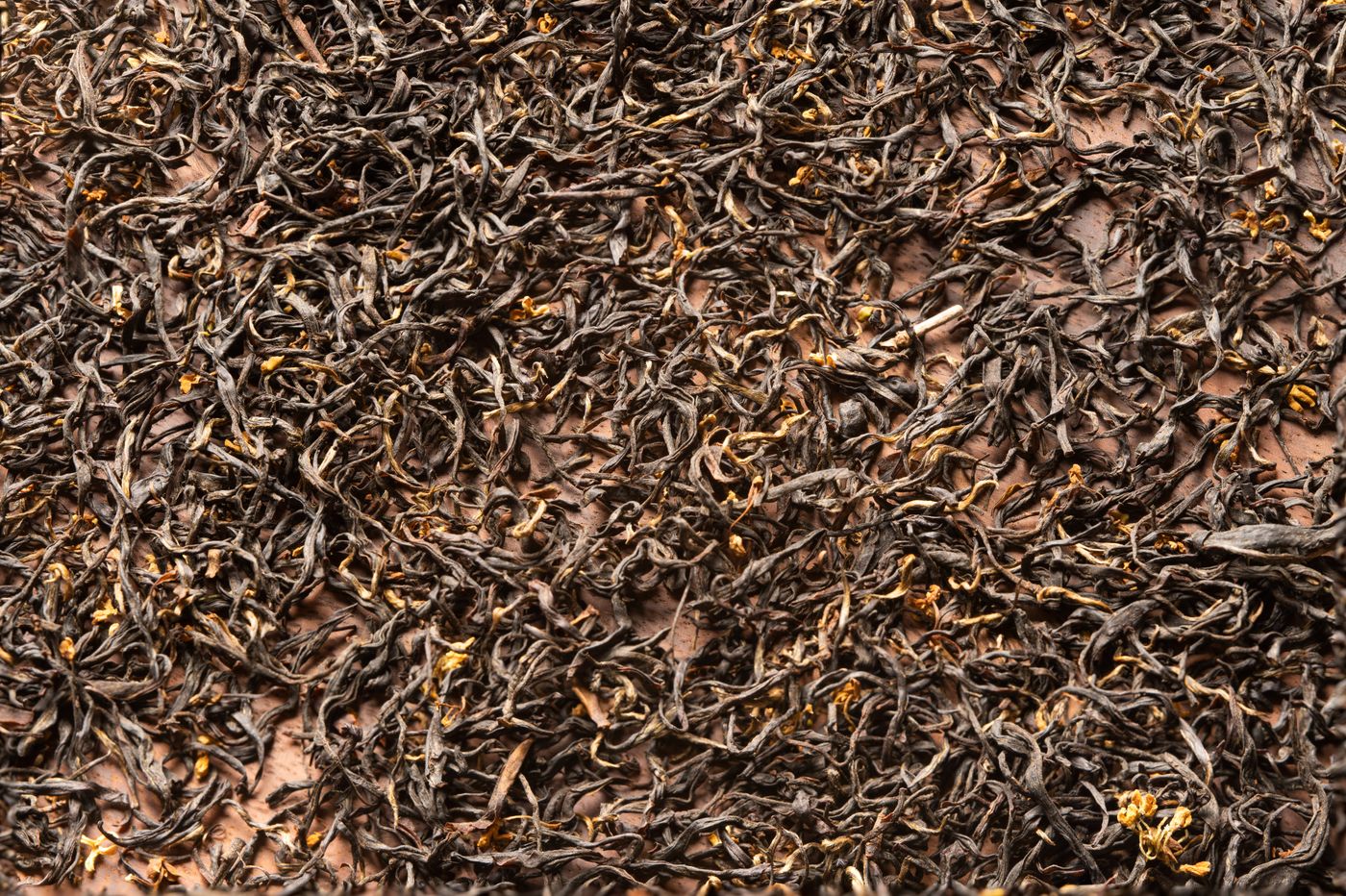
Take the smoked style first, since that is what most people mean. Dry leaf: long, thin, near-black twists that smell like a campfire the morning after. The liquor brews dark amber-red. First sip is smoke, pine and something meaty, close to smoked bacon. Underneath, if it is well made, a dried-fruit sweetness surfaces as the cup cools and the finish stays clean rather than acrid. A badly made one tastes like a chimney and nothing else, and the giveaway is that the sweetness never turns up.
The unsmoked style is a different experience entirely and, I think, a better tea. It brews clear bright red. The dominant note is dried longan, that honeyed, slightly musky sweetness, with malt, cooked plum and a resinous edge that reads as pine without any smoke involved. Almost no astringency. The sort of black tea you can drink four cups of without your mouth drying out.
Half my family is from Fujian, and the first time I took a tin of the export-strength smoked version back with me, it was received the way you would receive a novelty hot sauce. Politely. With confusion. Somebody asked why anyone would do that to good tea. It is a Fujian tea that Fujian mostly does not drink in that form.
How to brew Lapsang Souchong
The main mistake is treating the smoked version like an ordinary black tea. Smoke compounds keep extracting as long as the leaf sits in water, so a long steep at a full boil turns good tea tarry. Use less leaf and pull it early.
| Method | Leaf | Water | Temp | First steep | Resteeps |
|---|---|---|---|---|---|
| Mug or pot, smoked | 2–2.5 g | 250 ml | 90°C / 194°F | 2 min | 1–2 |
| Mug or pot, unsmoked | 3 g | 250 ml | 90–95°C / 194–203°F | 3 min | 2 |
| Gaiwan, gongfu | 5 g | 100 ml | 95°C / 203°F | Rinse, then 10 s, +5 s each | 6–8 |
| Cold brew | 8–10 g | 1 litre | Fridge | 6–8 hours | None |
| Iced, to drink with food | 4 g | 250 ml hot, poured over ice | 95°C / 203°F | 3 min | None |
Cold brewing a smoked Lapsang is worth trying even if it sounds wrong. Cold water pulls the sweetness and leaves much of the tar behind, giving a strange, savoury iced tea that goes very well with anything off a grill.
What to eat with it
Most tea is served alone or with something delicate. This one is the opposite: it stands up to food that would flatten any other tea, which is why it turns up in kitchens more than in tea rooms.
| Pair it with | Why it works |
|---|---|
| Smoked salmon, mackerel, kippers | Smoke meets smoke, and the tannin cuts through the oil |
| Aged cheddar, smoked gouda, blue cheese | Salt and fat give the smoke something to push against |
| Barbecue, grilled meat, anything charred | The tea already tastes like the cooking method |
| Mushrooms, lentils, roast root vegetables | Adds the savoury depth meat would have brought |
| Dark chocolate, 70% and up | Bitterness and smoke have always got along |
| Not: delicate white fish, salads, fresh fruit, cream cakes | The tea simply erases them |
It also cooks. Ground into a rub, steeped into a marinade or dropped into a broth, it gives you smoke without a smoker. Tea-smoking meat is a real Chinese technique, most famously the Sichuan camphor-and-tea smoked duck. Tea-smoked eggs are the easy version to try first.
How to buy it, and what we make instead
Four questions to ask a seller, in order of how much they tell you:
- Smoked or unsmoked? If they cannot answer immediately, they are not paying attention to their own stock.
- Tongmu, the wider Wuyi area, or somewhere else? Plenty of good smoked tea comes from elsewhere. A seller who admits it is being straight with you.
- How hard is the smoke? The range runs from a whisper to a bonfire. Ask where on that range this batch sits.
- Can you buy a small amount first? This is a polarising tea, and a large bag of something you hate is a waste of cupboard space.
One practical warning nobody gives you: smoked tea will scent everything near it. Keep it in its own sealed tin, in a different part of the cupboard from your green tea. Tea leaf is porous and picks up ambient aroma, the same property that makes jasmine scenting possible and makes storing Lapsang next to Longjing a mistake you only make once.
BornTea does not sell Lapsang Souchong. I would need a Tongmu relationship I have not built, and I am not willing to buy generic Fujian black tea, smoke it hard and put zheng shan xiao zhong on the bag. Plenty of people do exactly that.

What we do make is Dianhong, the golden-tipped black tea from Yunnan. If the part of Lapsang you like is the malt, honey and dried-fruit sweetness rather than the smoke, Dianhong gives you all of it with none of the fire: sweet potato, cocoa, a soft thick body, no astringency to speak of. It is the tea I would hand someone who tried smoked Lapsang, respected it, and did not want a second cup. More in our guide to Chinese black tea and the broader complete guide to black tea.
FAQ
What does Lapsang Souchong taste like?
The smoked style tastes of pine smoke, campfire and smoked bacon, with a dried-fruit sweetness underneath if it is well made. The unsmoked style, which is what most of China drinks, tastes of dried longan, malt, honey and cooked plum, with almost no astringency.
Why is Lapsang Souchong smoky?
Because the leaf is withered and dried over smouldering pine inside a wooden smokehouse, so the smoke is absorbed during processing rather than added later. Tongmu is cold and damp at picking time, and fire-drying was the reliable option long before smoke was a selling point.
Is Lapsang Souchong a black tea?
Yes. It is fully oxidised, and it is generally credited as the original black tea, the style every other black tea descends from. In Chinese it belongs to hong cha, "red tea", named for the colour of the liquor rather than the colour of the dry leaf.
Does Lapsang Souchong have caffeine?
Yes, roughly what any Chinese black tea has, commonly around 40 to 70 mg per 8 oz cup. Smoking does not change the caffeine content. Because the traditional picking uses more mature leaf rather than buds, some batches sit at the lower end of that range.
What can I use instead of Lapsang Souchong?
If you want the smoke, no other tea substitutes cleanly; a smoked black tea from outside Tongmu is the closest thing. If you want the malt and honeyed sweetness without the smoke, a Yunnan Dianhong or an unsmoked zheng shan xiao zhong is the better swap.
Want the sweet, malty half without the smoke? Start with our Dianhong, picked in Fengqing and screened for pesticides and heavy metals.