

Most loose leaf tea infusers make worse tea than no infuser at all, because they don't give the leaves room to open. A big open basket that sits down inside the mug is fine. A gaiwan is better. A tea ball, the little perforated sphere on a chain, is the worst of them, and it is everywhere.
The short version
- Leaves need space. Rolled oolong swells to several times its dry volume, and a tea ball physically cannot hold that.
- The tea ball is the single most common reason people decide they don't like loose leaf tea.
- A large basket infuser that fills most of the mug is the only clip-in device worth owning.
- A gaiwan or a lidded cup beats every infuser on the market and is easier to wash.
- No infuser at all works: drop the leaves straight in, top the mug up as you drink, and hold them back with the lid.
In this post
Why most tea infusers make worse tea
Brewing is water moving through leaf. That is the whole mechanism. Hot water has to circulate around each piece of leaf, pull the soluble compounds out, carry them away and be replaced by more water. Anything that stops the circulation stops the extraction.
Squeeze three grams of leaf into a container the size of a walnut and you get a packed clump. Water reaches the outside of the clump and never properly reaches the middle. The outer leaves over-extract and turn sharp while the inner ones sit there barely wet. What you pour out is thin, flat and slightly harsh at the same time, which is a difficult trick to pull off.
Then the honest, reasonable conclusion follows: this tea is not very good. Except the tea was fine. The container was the problem.
Worth noting that the international standard for preparing tea for tasting, ISO 3103, has the leaf loose in the pot and the liquor poured off through a strainer. Nobody designing a fair test of tea puts the leaf in a cage.
How much room do tea leaves actually need?
More than you think, and it varies enormously by how the leaf was shaped. These are approximate figures from watching a lot of leaf open in glass, not laboratory measurements, but the pattern holds.
| Leaf type | Dry form | Roughly how much it swells | What it needs |
|---|---|---|---|
| Rolled oolong | Tight pea-sized balls | 4 to 5 times its dry volume | The most room of any tea. Never confine it |
| Curled green | Fine downy spirals | 3 to 4 times | Room to sink and rise; will clog fine mesh |
| Pan-fired green | Flat pressed spears | 2 to 3 times | Depth to float and settle |
| Twisted black | Long wiry strips | 2 to 3 times | Length, so the strips can straighten out |
| Large-leaf white | Whole open leaves and buds | Swells little, but starts enormous | Bulk space. Fits almost nothing but a mug |
| Compressed pu-erh | Broken chunk | Loosens and spreads across several steeps | A vessel, not a device |
| Broken leaf and fannings | Small particles | Barely swells | Almost nothing, which is why tea bags work |
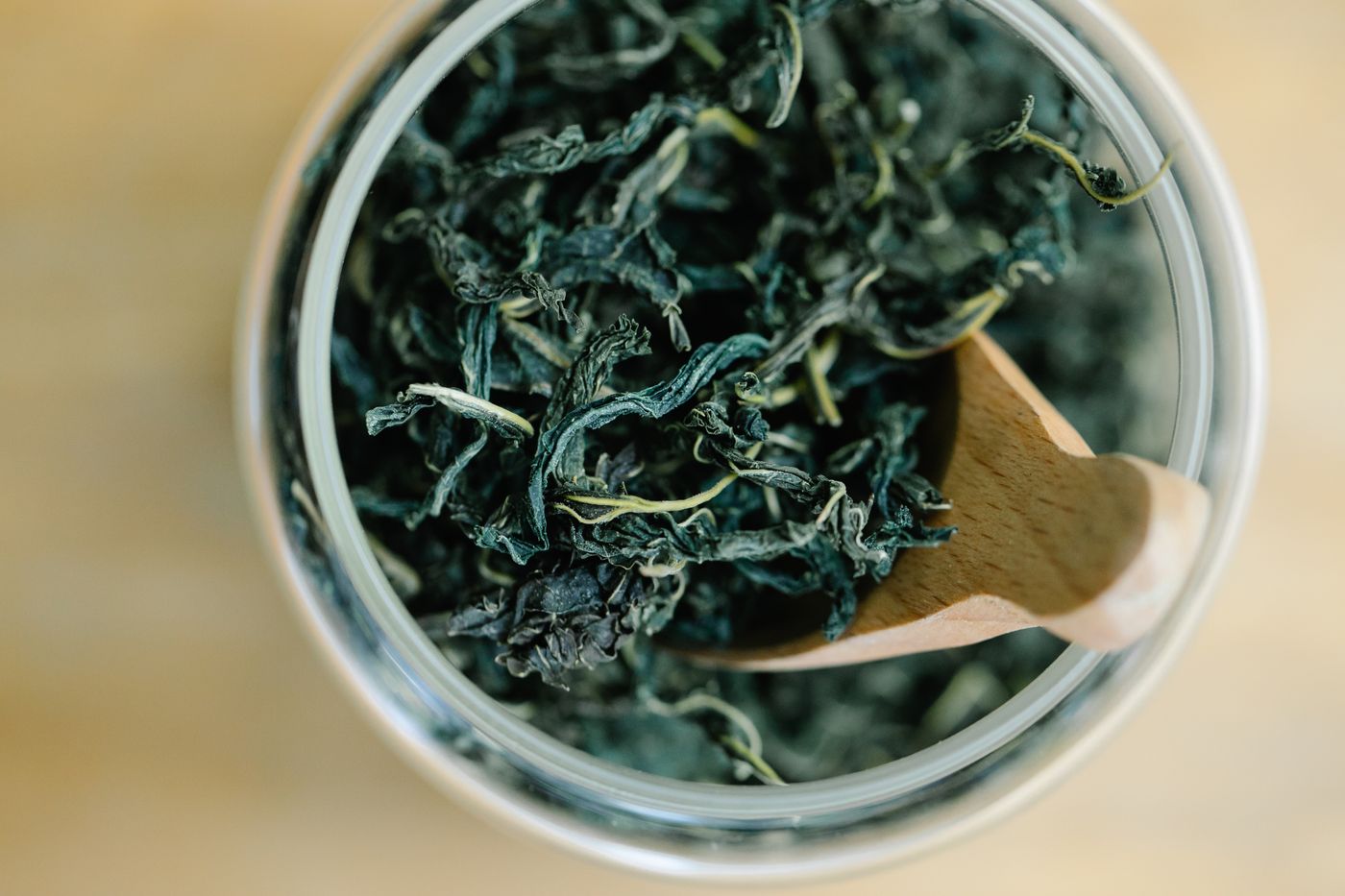
That last row explains a great deal. Tea bags are filled with fannings and dust, the smallest grades, which have so much surface area relative to their size that they extract fast even when packed tight. Loose leaf is the opposite. It is whole, it is slow, and it needs space to do its work. Put whole leaf into a container designed around the physics of dust and you get the worst of both.
Every type of tea infuser, compared
Rated on what actually matters: how much room the leaf gets, how annoying the thing is to clean, and whether I would put my own tea in it.
| Type | Leaf room | Cleaning | What it suits | Verdict |
|---|---|---|---|---|
| Tea ball (mesh sphere) | Almost none | Poor. Leaf jams in the hinge | Nothing, honestly | Avoid |
| Ball on a chain, or spoon clamp | Almost none | Worse. Two hinges now | Nothing | Avoid |
| Silicone novelty shapes | Almost none | Awkward, and silicone holds smells | Being a present | Avoid |
| Small basket or lid infuser | Middling | Easy | Black tea, short steeps, small leaf | Acceptable |
| Large basket that fills the mug | Good | Easy. Rinse and tip out | Everyday mug brewing, any leaf | Buy this one |
| Paper filter bag you fill yourself | Good, if you fill it loosely | None. Bin it | Travel, the office, sharing samples | Underrated |
| Gaiwan or lidded cup | Total | Easiest of all. No mesh | Every Chinese tea, every strength | Best result |
| Teapot with a wide built-in strainer | Good | Easy | Serving two or more people | Good |
| No infuser at all | Perfect | Rinse the mug | Green, white, jasmine, sheng pu-erh | Better than any tea ball, and free |
Notice the pattern. Every device rated "avoid" is small and enclosed. Every device rated well is either open, large, or absent. There is no clever engineering here. Room is the entire variable.
The tea ball problem
A standard tea ball is around four centimetres across. Do the geometry and the inside comes to roughly thirty millilitres of space, and a good part of that is taken up by the mesh curvature and the hinge. Now put in the two and a half to three grams of leaf a 250 ml mug wants. Rolled oolong at that weight needs somewhere north of sixty millilitres once it has opened. It cannot open. It presses against the mesh and stays a lump.
People then adapt in the worst possible direction: they use less leaf so it fits. Now the tea is weak by design as well as by accident, and the outer layer is being over-steeped to compensate. I have watched people do this, taste the result, and quietly go back to bags. Which is fair. Bags were better.
I have been given three tea balls as gifts over the years, all from people who knew I was in tea and had chosen thoughtfully. Every one of them is in a drawer. I have never been able to bring myself to say anything, because the thought was genuinely kind, and because the alternative is explaining sphere volume to someone at a birthday.
So, plainly: the tea ball is the single most common reason people think they don't like loose leaf tea. If you own one and you have been disappointed by loose leaf, try the same tea loose in a mug tomorrow morning before you blame the leaf.
Brewing with no infuser at all
This is how an enormous number of people in China actually drink tea, and it needs no equipment whatsoever. It is sometimes called grandpa style, which is affectionate rather than dismissive.
- Put a small pinch of leaf straight into a tall glass or a mug. Less than you would use for a normal brew, roughly half a gram per 100 ml, so about a gram in a mug.
- Fill with hot water. For green and white teas let it stand a minute off the boil first.
- Wait for the leaves to sink. Most of them will. Then drink, slowly, from the top.
- Top the mug up before it gets low. Do this all morning. The leaf keeps giving for four or five refills.
The trick that makes it civilised is the lid. Any lid: a saucer, a jar lid, the lid of a travel cup. Tilt it slightly and pour past it, and it holds the leaves back exactly the way a gaiwan lid does. That is all a gaiwan is, and it is why a gaiwan outperforms every infuser you can buy.

Two honest limits. You will drink a few leaves; use less leaf and it stops being an issue. And it suits some teas far better than others. Greens, jasmine, whites and young sheng are excellent this way because they stay sweet under long contact. Strong black teas and shou pu-erh turn heavy and bitter, so those want a proper steep and a pour-off, which is covered in our guide to brewing loose leaf tea properly.
Cleaning, and why old infusers flatten every tea
Fine mesh traps tea oils. Those oils oxidise, go stale and then quietly transfer a dull, slightly rancid background note into everything you brew afterwards. If every tea you own has started tasting vaguely the same, look at your equipment before you blame your palate.
- Empty it while it is still wet. Dried leaf welds itself into mesh and takes a brush and bad language to remove.
- Rinse with hot water, not detergent. Detergent lodges in fine mesh and soap in your tea is worse than stale oil. A soft brush handles the rest.
- Deal with browning early. A short soak in hot water with a splash of white vinegar, then a thorough rinse, lifts the film off stainless mesh.
- Dry it fully before it goes in a drawer. Damp mesh in a dark drawer is how equipment starts to smell.
- Replace deformed mesh. Once a basket has been squashed and no longer sits flat, leaf escapes around the rim and you have a strainer that does not strain.
- Silicone is the exception. It absorbs odour and rarely gives it back. If a silicone infuser smells of something, it is finished.
Porcelain and glass have none of these problems, which is the quiet argument for both.
What I would actually buy
In order, and the first one is free.
- Nothing. Try a week of leaves loose in the mug before you spend anything. A lot of people stop here.
- A gaiwan or a lidded cup. Total leaf room, no mesh to clean, works with every tea. A simple lidded cup does the same job as a gaiwan with a friendlier handle, and a double-wall glass bottle does it for tea you carry around.
- One large basket infuser that reaches most of the way down your mug. Stainless steel, fine enough for downy greens, no hinges. This is the only clip-in device I would own.
- A bottle with a real basket in it for out of the house. Most travel infusers are tea balls with delusions; look for one with a proper wide chamber, like a double-wall glass bottle where the leaves have somewhere to go.

Skip everything shaped like an animal, a submarine or a tiny house. I know they are charming. They hold about a thimble of leaf, they are miserable to clean, and they will make you think your tea is worse than it is.
FAQ
What is the best loose leaf tea infuser?
A large stainless basket that sits deep in the mug, or better, no infuser at all. The basket wins because the leaves get room to open and water can circulate around them. Gaiwans and lidded cups beat every basket, since there is no mesh involved.
Are tea balls bad for loose leaf tea?
Yes. A typical tea ball holds around thirty millilitres, and whole leaf needs several times that once it swells. The leaf packs tight, water cannot circulate, and the result is weak and slightly harsh at once. It is the most common cause of disappointing loose leaf tea.
Can you brew loose leaf tea without an infuser?
Easily. Put a small pinch of leaf straight into the mug, add hot water, wait for the leaves to sink and drink from the top, topping up as you go. Hold the leaves back with any lid or saucer when you pour. It suits greens, whites and jasmine best.
How do you clean a tea infuser properly?
Empty it while the leaf is still wet, rinse under hot running water and use a soft brush on the mesh. Skip the detergent, which lodges in fine mesh. For brown staining, soak briefly in hot water with a splash of white vinegar, rinse well, and dry it completely.
How much loose leaf tea goes in an infuser?
About one gram per 100 ml of water, so roughly two and a half grams in a standard mug. If that amount will not fit loosely in your infuser with room to spare, the infuser is too small for the job rather than the measurement being wrong.
If you want a container where the leaf can actually move, start with a double-wall glass bottle and watch what the leaves do when you give them the space.