

Osmanthus tea is tea scented with the tiny golden flowers of Osmanthus fragrans, the shrub the Chinese call gui hua. It smells of apricot and honey with a peach-skin sweetness behind it. You will meet it two ways: osmanthus scented into green, black or oolong tea, and dried blossom brewed alone, which has no caffeine at all.
The short version
- Osmanthus tea is a scented tea. Gui hua (桂花), sweet osmanthus, is the flower; the base is usually green, black or oolong.
- The aroma is apricot and honey with a warm stone-fruit sweetness. Rounder and less sharp than jasmine.
- Pure osmanthus blossom infusion has no caffeine. Osmanthus scented into tea does, because the tea leaf underneath does.
- It is an autumn drink in China. The tree flowers in September and October, and for a fortnight whole streets smell of it.
- Scenting osmanthus is the same craft as scenting jasmine, and the rule is the same: aroma in the leaf, not sprayed on it.
- We don't make an osmanthus tea. The closest thing in our range is properly scented jasmine.
In this post
What is osmanthus tea?
Start with the plant, because it is not a tea plant. Osmanthus fragrans is an evergreen shrub or small tree in the olive family, native to China and neighbouring parts of Asia, and the NC State Extension plant toolbox lists it as sweet osmanthus or fragrant tea olive. The flowers are absurdly small, four or five millimetres across, in clusters at the leaf joints, ranging from pale cream through butter-yellow to deep apricot-orange. That is where the Chinese names come from: jin gui, golden osmanthus, and yin gui, silver osmanthus. The aroma is out of all proportion to their size. One mature tree perfumes a whole courtyard.
Osmanthus tea is therefore one of two things. Either real tea leaf scented with those flowers, in which case it behaves like whatever tea sits underneath. Or dried blossoms brewed alone, no tea leaf involved, which is a flower infusion in the way chamomile is. Both are called gui hua cha in Chinese and both are called osmanthus tea in English, which is where most of the confusion online starts.
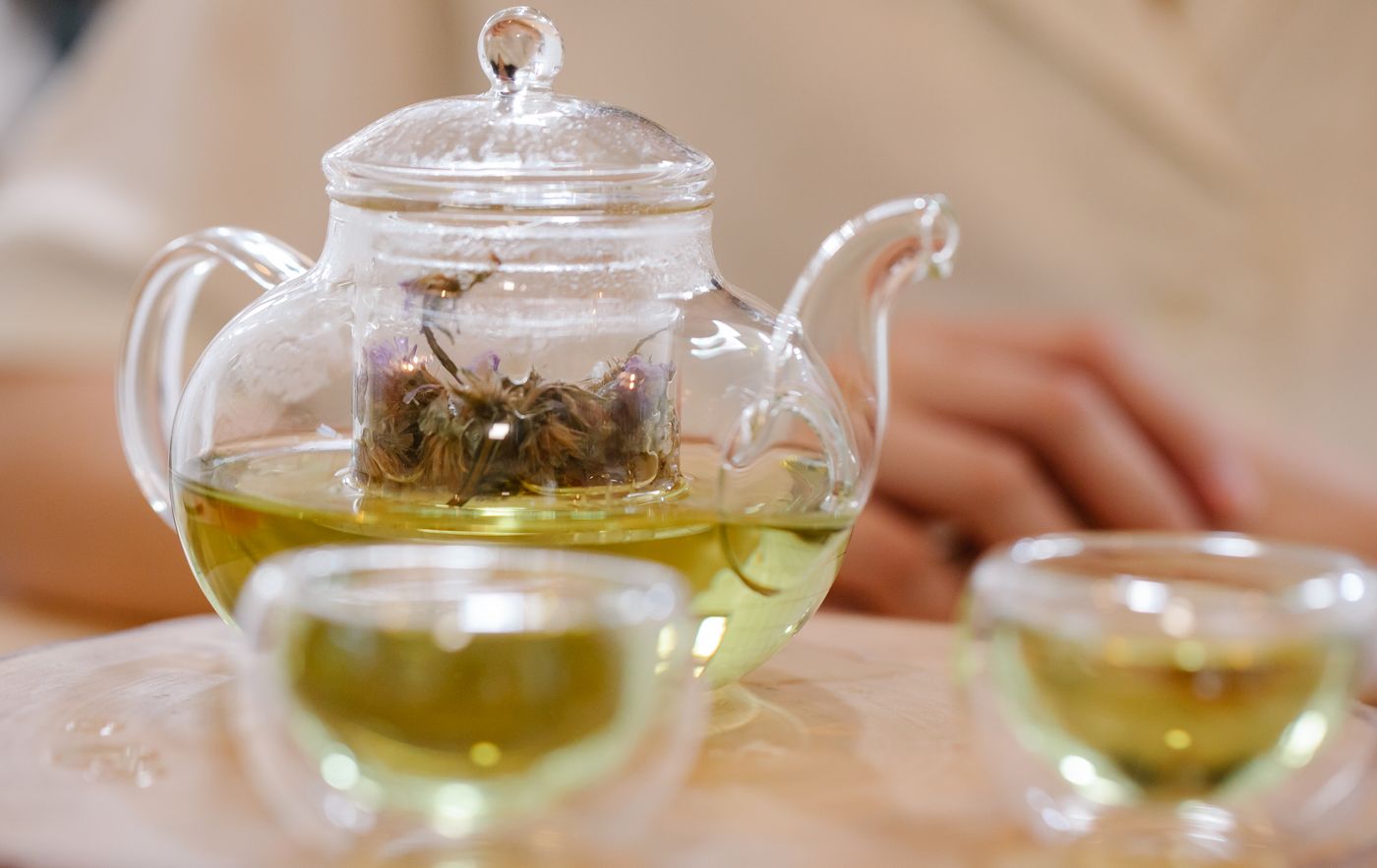
What does osmanthus tea taste like?
Apricot first. That is the note nearly everyone lands on, and it is a specific apricot: dried rather than fresh, with the honeyed edge dried apricot has. Behind it, peach skin, a little cooked-sugar warmth and a soft floral-woody base that stops the whole thing tasting like dessert.
Compared with jasmine, which is bright, cool and slightly green, osmanthus is warmer and rounder. Jasmine lifts. Osmanthus settles. Jasmine can be piercing when it is done well; osmanthus never is, which makes it the easier of the two for anyone who finds scented tea overbearing.
The taste is subtler than the smell, which surprises people. Most of what osmanthus gives you is aroma, and much of that arrives after you swallow. The liquor itself is light, faintly sweet, low in bitterness. If your cup tastes soapy rather than fruity, you used too much flower or brewed it too hot. Both are easy to fix.
The four forms of osmanthus tea
| Form | Base tea | Aroma and taste | Caffeine | When I'd drink it |
|---|---|---|---|---|
| Pure osmanthus blossom | None, flowers only | Apricot and honey, delicate, turns soapy if you overdo it | None | Late evening, or after a heavy meal |
| Osmanthus green | Green tea | Fresh and sweet, flower sitting on a grassy base | Yes, roughly a green tea's | Daytime, with light food |
| Osmanthus black | Chinese black tea | Honey and malt, the fullest and most forgiving of the four | Yes, roughly a black tea's | Morning, with breakfast |
| Osmanthus oolong | Rolled or lightly roasted oolong | Apricot over cream and orchid, the most interesting of them | Yes, roughly an oolong's | Afternoon, brewed gongfu |
| Osmanthus pu-erh (less common) | Ripe shou pu-erh | Flower against damp earth. People are divided | Yes | Cold weather |
Buying your first one, I would push you toward osmanthus oolong. Rolled oolong has a creamy, orchid-ish character that meets the apricot halfway instead of being buried by it. Osmanthus black is the safest. Pure blossom is the one people buy expecting tea and then find thin, so know what you are getting.
Osmanthus season, and why the timing matters
Osmanthus flowers in autumn. In most of China that means late September into October, and it is short: a good flush lasts a week or two, and heavy rain can end it early. Everything made from the flower has to be made in that window.
The smell arrives before the tree does. You walk down a street in September, turn a corner, and there it is, warm apricot sweetness with nothing visible to explain it, because the flowers are tiny and hidden under the leaves. Part of my family comes from Guangxi, where the best-known city is named after the tree: Guilin means osmanthus forest. Autumn there smelled like someone had been stewing dried apricots two streets away and would not admit it. Harvesting is as low-tech as you would guess: a sheet under the tree, the branches shaken, then hours of picking out twigs.
Hangzhou takes osmanthus as its city flower, and in flowering season people go out to the hills to sit under the trees and drink tea. In Chinese homes the flower has long been a cold-weather comfort served after a heavy meal, and I will leave the traditional framing there rather than repeat the health claims attached to it online.
The consequence for a buyer: osmanthus is seasonal in a way jasmine is not, and dried blossom loses aroma over a year. Buying in autumn from someone who tells you the harvest year gets you a far better product than buying in June from a jar open since last September.
How scenting works
Tea leaf is porous and slightly fatty, so it absorbs whatever it is stored near. A curse beside the coffee, a virtue beside flowers. Scenting, yin zhi in Chinese, is the craft built on that property, and one of the techniques recognised in UNESCO's 2022 listing of China's traditional tea processing.
The method is simple to describe and tedious to do. Dry finished tea is layered with fresh flowers picked that day. The flowers keep releasing aroma for hours as they wilt, and the leaf takes it up. The spent flowers are sieved out, the tea is re-dried to drive off the moisture they added, and for better grades the whole thing repeats with a fresh batch. Top-grade jasmine goes through that cycle many times over several weeks. Osmanthus usually gets fewer rounds, partly because the flower is potent and partly because the season does not allow more.
Which leads to the rule I would apply to any scented tea, ours included: the aroma should live in the leaf. Open a bag of well-scented tea and the dry leaf should smell of the flower, strongly, before any water goes near it.
One honest caveat specific to osmanthus. With top-grade jasmine all the flowers are removed, so visible petals are a warning sign. With osmanthus, producers often leave the golden blossoms in on purpose, because they look good and keep giving aroma in the cup. Visible flowers are not the tell here. The tell is the smell of the dry leaf and whether the base tea is any good on its own. A weak, dusty base covered in flowers is a cheap tea in fancy dress, and much of what sells cheaply online is exactly that, or a plain tea sprayed with an aroma compound rather than scented at all. Check the ingredients for the word "flavouring".
The same craft done properly is what our jasmine green tea guide covers, with a sensory breakdown in what jasmine tea tastes like.
How to brew osmanthus tea
Two rules cover most of it. Use less flower than feels right, and keep the water below boiling. Osmanthus goes from fragrant to soapy fast, and heat pushes it over.
| What you're brewing | Per 250 ml | Temp | First steep | Resteeps |
|---|---|---|---|---|
| Pure osmanthus blossom | 1–1.5 g, a generous pinch | 85–90°C / 185–194°F | 2–3 min | 1–2 |
| Osmanthus green | 2.5–3 g | 80–85°C / 176–185°F | 2 min | 2 |
| Osmanthus black | 3 g | 90–95°C / 194–203°F | 3 min | 2 |
| Osmanthus oolong, western | 3 g | 90–95°C / 194–203°F | 3 min | 2–3 |
| Osmanthus oolong, gongfu | 6 g per 100 ml | 90–95°C / 194–203°F | 20 s, then +5 s each | 6–8 |
| Cold brew, any scented version | 8–10 g per litre | Fridge | 6–8 hours | None |
Cold brew deserves a mention. Floral aroma survives cold extraction well and bitterness mostly does not, so a cold-brewed osmanthus green is one of the more flattering things you can do with the style. It takes eight hours, so start the night before.
A brewed cup keeps its aroma for less time than you expect. Drink it hot, or let it go properly cold and put ice in it. The lukewarm middle is where scented teas taste worst.
What to look for, and what we make instead
Four checks before you buy:
- Smell the dry leaf if you can. Real scenting is obvious from the bag. If you have to brew it to find the flower, there is not much in it.
- Ask what the base tea is, and whether they would sell it unscented. A producer proud of the base is not hiding anything with the flower.
- Read the ingredients. "Green tea, osmanthus flowers" is what you want. "Natural flavouring" is a different product being sold under the same name.
- Check the harvest year. Osmanthus fades. Autumn flower bought the following summer is a shadow of itself.
Store it sealed, away from light and away from your other teas, since the same porousness that makes scenting possible will happily move the apricot smell into your Longjing.
BornTea does not currently make an osmanthus tea. The honest reason: the flowering window is a fortnight, the scenting has to happen inside it, and I have not yet found a producer whose base tea I would put our name on. When I do, I will make it.

The scented tea we do make is jasmine green tea, done the traditional way with fresh blossom layered against finished green tea over repeated rounds, and the flowers sieved out at the end. Different flower, cooler and brighter than osmanthus, exactly the same craft. If you like the idea of a tea that smells of a specific plant in a specific fortnight of the year, that is the one to start with.
FAQ
What does osmanthus tea taste like?
Dried apricot and honey, with peach skin behind it and a soft floral-woody base. Most of the character is aroma rather than flavour, and the liquor itself is light and only faintly sweet. Warmer and rounder than jasmine, which is brighter and greener by comparison.
Does osmanthus tea have caffeine?
It depends which one you have. Pure dried osmanthus blossom brewed on its own contains no caffeine, because it is a flower infusion with no tea leaf in it. Osmanthus scented into green, black or oolong tea carries whatever caffeine that base tea carries.
What is osmanthus tea good for?
In China it is a traditional autumn drink, often served after a heavy meal. I am not going to tell you it treats anything. What it is genuinely good for is making an ordinary green or black tea smell like an orchard.
Is osmanthus tea the same as jasmine tea?
No, though they are made the same way. Both are scented teas, where fresh flowers are layered with finished tea leaf so the leaf absorbs the aroma. The flower is different: osmanthus gives apricot and honey, jasmine gives a cooler, brighter, greener perfume.
Can you drink osmanthus tea every day?
Plenty of people do. If it is scented onto a tea base, treat it like any tea of that type and count the caffeine. If it is pure blossom, the limit is taste: a strong osmanthus infusion starts tasting soapy well before you tire of it.
Like the idea of a tea that carries a flower's aroma? Our jasmine green tea is scented with fresh blossom rather than flavouring, and screened for pesticides and heavy metals.