

Oolong tea is a semi-oxidised Chinese tea made from Camellia sinensis, the same plant that gives us green tea and black tea. What makes it oolong is where the processing stops, somewhere between the two. That single decision is why one oolong can taste like orchids and another like toasted grain and dark stone fruit.
Updated August 2026.
The short version
- Oolong sits between green and black tea: partly oxidised, anywhere from roughly 10% to 80% depending on the maker.
- It has the widest flavour range of any tea category, from light and floral to dark and roasted.
- Caffeine is moderate, commonly cited at roughly 30 to 60 mg per 8 oz cup, well under brewed coffee.
- Good oolong resteeps five or six times. The second and third steeps are usually the best ones.
- Brew it hot, around 95°C (205°F). Oolong does not scorch the way green tea does.
In this post
What is oolong tea?
Every true tea in the world comes from one plant. Green, white, oolong, black, pu-erh: all Camellia sinensis. The category is decided by what happens to the leaf after it is picked, and specifically by how far the leaf is allowed to oxidise before heat stops the process.
Green tea is fired almost immediately, so oxidation never really starts. Black tea is crushed and left to oxidise fully. Oolong is the one that stops in the middle. The leaves are withered in the sun, then bruised, usually by tumbling or shaking them so the edges break, and then oxidised in stages until the maker decides it is done. Then heat locks it in.
That window is enormous. A light Tie Guan Yin might be only 15% oxidised and taste closer to a green tea. A heavily roasted Wuyi rock oolong might be 70% or more and taste closer to a black tea. Both are correctly called oolong. This is why "what does oolong taste like" has no single honest answer, and why people who say they do not like oolong have usually only tried one.
Oolong also happens to be rare. It makes up a small share of world tea production, well under a tenth, because it is difficult and labour-intensive to make. The margin for error is narrow and the process cannot be rushed.
The history of oolong tea
There are several stories about how oolong tea was discovered, and no way to settle between them. All three are worth knowing.
First, the "tribute tea" theory. The name oolong is said to be a nod to its predecessor, the Dragon-Phoenix tea cakes famous during the Song Dynasty (960 to 1279 CE). As loose-leaf tea replaced compressed cakes, the old name gave way. Since the finished leaf is dark, long and curly, it was called wūlóng, literally dark dragon.
Second, the Wuyi theory. This one holds that oolong originated in the Wuyi Mountains of Fujian and took its name from a part of the range where it was first made. Qing Dynasty poems, including the Wuyi Tea Song, are usually offered as supporting evidence.
Third, the Anxi theory, which is the most human of the three. A man named Sulong, or Wulong depending on who is telling it, left his picked leaves out too long after being distracted by a deer he was hunting. The leaves oxidised at the edges. He brewed them anyway. They were better.
I have no idea which is true. I lean toward the third, because that is how most good food gets invented: somebody makes a mistake and is honest enough to taste it.
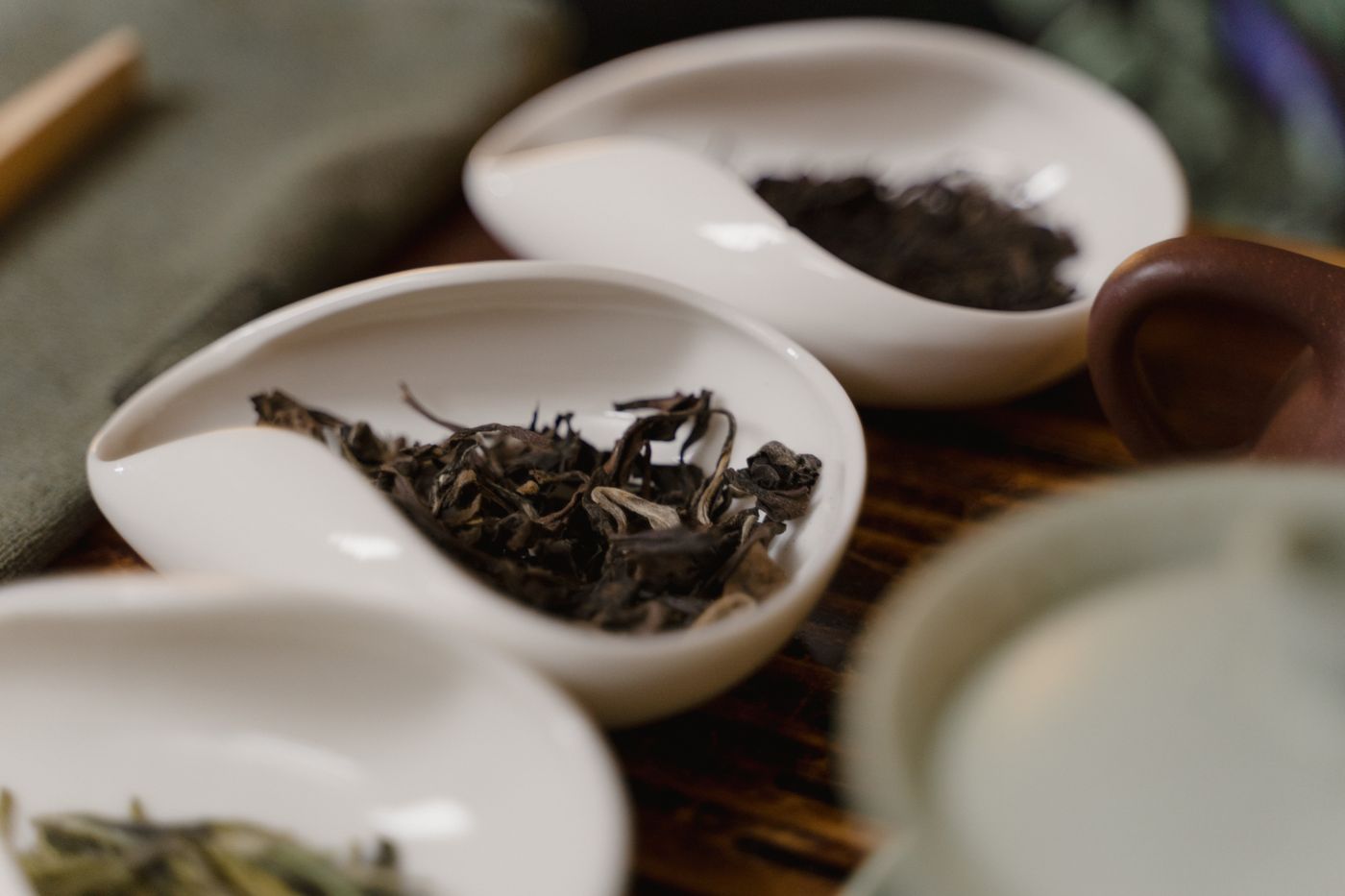
What does oolong tea taste like?
Because oolong is semi-oxidised, the flavour depends on how far the maker took it, and on whether the tea was roasted afterwards.
Lightly oxidised oolong tastes fresh, bright and floral. Orchid and lilac come up a lot, and the liquor is pale gold. More oxidised and roasted oolong goes the other way: warmer, darker, with notes people describe as toasted grain, honey, dried fruit or wet stone. In between you get peach, apricot, cream and butter.
The one thing nearly all oolong shares is a low astringency. It is rounder in the mouth than green or black tea, and much more forgiving if you over-steep it slightly. That makes it a good tea to learn on.
One more thing that surprises people: the aroma of the wet leaf, after you rinse it, is often stronger and more beautiful than the aroma of the tea in the cup. Lift the lid and smell it. That step is free and most people skip it.
Types of oolong tea
Do you still remember the three theories of how oolong tea was discovered? From those stories, we can already sense that there are several different types of oolong tea. Here are the five most famous types of oolong tea in the world:
-
Phoenix Tea (Dan Cong)
Produced in Guangdong Province in southern China, Phoenix oolong is one of the best-selling oolongs. As the name suggests, it comes from the Phoenix mountains in Guangdong. It is known for its natural flavours and aroma: full-bodied, rich and fragrant. The best Dan Cong are named for the flower or fruit they mimic, without anything being added to them.
-
Iron Goddess of Mercy (Tie Guan Yin)
If you are in doubt about which oolong to try first, try Iron Goddess of Mercy. It is grown in the mountainous region of Anxi, in Fujian Province. The tea got "Iron" in its name from the laborious processing method, which traditionally includes many hours of slow roasting. It tastes floral, light and airy, often compared to an orchid. There is a longer guide to Tie Guan Yin if you want the full story of how it is made.
-
Wuyi Oolong Tea (Da Hong Pao)
Where Iron Goddess of Mercy is a "light" oolong, Wuyi oolong is the opposite: a dark one. It has a sharp, smoky, deep flavour that comes from a high oxidation level, heavy roasting and the mineral-rich cliffs it grows on. Some of these teas are among the most expensive in the world. We wrote about why Da Hong Pao costs what it does, including the part about the mother trees.
-
High Mountain Oolong Tea (Gaoshan)
As the name suggests, High Mountain oolong comes from mountainous areas of central Taiwan. It is generally lightly oxidised, which puts it closer to green tea than to black. The altitude slows the plant down, and the result is a light, crisp, floral tea with a thick texture.
-
Milk Oolong Tea (Jin Xuan Tea)
Can plain tea be creamy? Milk oolong is the answer. It tastes creamy and sweet thanks to the Jin Xuan cultivar, grown at lower altitude and usually picked in spring. Do not get it wrong, this tea is not milky because anyone put milk in it. Good Jin Xuan is naturally buttery. Be aware that some cheap versions on the market are flavoured artificially, so buy from someone who will tell you plainly which one you are getting.
At a glance:
| Type | Origin | Oxidation | Tastes like |
|---|---|---|---|
| Phoenix (Dan Cong) | Guangdong | Medium to high | Stone fruit, honey, orchid |
| Tie Guan Yin | Anxi, Fujian | Low (modern) to high (traditional) | Orchid, cream, lilac |
| Wuyi (Da Hong Pao) | Wuyi Mountains, Fujian | High, heavily roasted | Toasted grain, mineral, dark fruit |
| High Mountain (Gaoshan) | Central Taiwan | Low | Crisp, floral, thick texture |
| Milk Oolong (Jin Xuan) | Taiwan | Low | Buttery, sweet, milky |
The differences between oolong, green, and black tea
All three come from Camellia sinensis. The differences are in the processing, and everything else follows from that.
| Green | Oolong | Black | |
|---|---|---|---|
| Oxidation | None | Partial, roughly 10–80% | Full |
| Leaf handling | Fired or steamed at once to stop oxidation | Withered, bruised, part-oxidised, then fired | Withered, crushed, fully oxidised |
| Taste | Grassy, fresh, vegetal | Floral through fruity to roasted | Malty, brisk, robust |
| Astringency | Higher | Lowest of the three | Higher |
| Water temp | 75–80°C | 95°C | 95–100°C |
| Caffeine, 8 oz | ~25–45 mg | ~30–60 mg | ~40–70 mg |
If you want the full picture on the other two, we have a complete guide to green tea as well.
The caffeine content of oolong tea
Oolong tea typically contains roughly 30 to 60 mg of caffeine per 8 oz (240 ml) cup. Brewed coffee is usually in the region of 95 to 165 mg for the same volume, so a cup of oolong is commonly around a third to a half of a cup of coffee. The Mayo Clinic's caffeine chart is a good reference point if you want to compare against other drinks.
Those are ranges, not promises, and the range matters more than the midpoint. How you brew changes the number substantially: hotter water, longer steeps, more leaf and more broken leaf all pull out more caffeine. The same tea brewed two ways can differ by a wide margin. Steep time and water temperature will move your cup more than switching from one oolong to another will.
Worth knowing: the first short steep in gongfu brewing extracts a good deal of the caffeine, so later steeps are gentler. If caffeine bothers you in the evening, drink the third and fourth steeps rather than the first.
We went deeper on this in a dedicated post: does oolong tea have caffeine, with the full comparison against green, black and coffee.
Is oolong tea good for you?
Oolong is a plain plant infusion with no sugar, no calories to speak of, and a moderate amount of caffeine. For most healthy adults it is a sensible everyday drink, and people have drunk it daily in southern China and Taiwan for centuries.
Like other teas from Camellia sinensis, it contains caffeine, polyphenols and the amino acid L-theanine. Many people find the combination of caffeine and L-theanine gives them a steadier kind of alertness than coffee does, without the same jitter. That is a description of how it tends to feel, not a medical claim.
I want to be straight with you here, because a lot of tea writing is not. You will find pages online claiming oolong treats or prevents various diseases. The honest position is that research on tea and health is mostly preliminary, often done in small groups or in laboratories rather than in people, and nowhere near strong enough to justify those claims. We used to have a version of that list on this very page. We took it down.
What is reasonable to say: it is a pleasant, low-calorie drink that many people find helps them wind down or focus. The caffeine is real, so if you are sensitive to it, or pregnant, or on medication, keep an eye on your total daily intake and talk to your doctor about what is right for you. The FDA cites 400 mg a day as a figure not generally associated with negative effects for healthy adults, which is a lot of oolong.

The best way to drink oolong tea
There are two ways to make oolong: the everyday cup method, and the gaiwan method. Both are correct. I use the first on weekday mornings and the second when I have twenty minutes and nothing to do.
| Method | Leaf | Water | Temp | Steep time |
|---|---|---|---|---|
| Cup or mug | 2 g (about 2 tsp) | 250 ml (8.5 oz) | 95°C / 205°F | 3–5 min |
| Gaiwan (gongfu) | 4–5 g | 100–120 ml | 95°C / 205°F | 15s, then 25s, 40s, 60s, 80s, 100s |
Cup method. Preheat the cup with hot water and discard it. Add the leaf, pour in near-boiling water and steep for three to five minutes. Oolong is forgiving, so a minute either way will not ruin it.
Gaiwan method. A gaiwan, literally lid and bowl, is the traditional Chinese brewing vessel and the one I would buy first if I were starting over. Preheat it, discard the water. Add the leaf, pour in hot water and immediately pour it off. That rinse is called awakening the tea, and it opens the rolled leaves up. Pour the rinse water into your cup to warm it, then discard.
Now brew properly. Fifteen seconds for the first steep, then pour into a cup rather than drinking from the gaiwan directly. Add roughly ten to twenty seconds to each following steep. You should get five or six good steeps out of decent oolong, and the second and third are usually the best of the session. If you want the longer version, here is how to use a gaiwan without burning your fingers.
The mistake I see most often is treating oolong like green tea and brewing it too cool. Rolled oolong leaves are tightly balled and need real heat to open. Lukewarm water gives you a thin, disappointing cup and people conclude they do not like oolong, when what they do not like is under-brewed oolong.
Where to buy oolong tea
Buy oolong from someone who can tell you where it came from and roughly when it was picked. Vagueness on either point is the tell. "Chinese oolong tea" on a supermarket tin means nobody involved wants to be specific.
My family is from Yunnan and Fujian, and Anxi in Fujian is where Tie Guan Yin comes from. I buy ours there directly from the people who make it, which is the whole reason BornTea exists: no brokers, no re-packers, and a price that reflects the tea rather than the number of hands it passed through. Every batch is screened by an independent lab for pesticides and heavy metals before it ships, because farm-direct only means something if you can prove what is in the leaf.

If you want a fresh, brisk, orchid-sweet oolong to start with, our Tie Guan Yin oolong tea comes straight from Anxi to your door.
FAQ
Is oolong tea green tea or black tea?
Neither. Oolong is its own category, sitting between the two. It is partly oxidised, where green tea is not oxidised at all and black tea is fully oxidised. A lightly oxidised oolong resembles green tea, and a heavily roasted one resembles black tea, but both are still oolong.
Does oolong tea have caffeine?
Yes. Oolong typically contains roughly 30 to 60 mg of caffeine per 8 oz cup, which puts it between green and black tea and well below brewed coffee. Your brewing method changes this more than your choice of oolong does: hotter water and longer steeps extract more.
How many times can you resteep oolong tea?
Five or six times using the gaiwan method, sometimes more with a high-quality rolled oolong. Add about ten to twenty seconds to each successive steep. Most people find the second and third steeps are the best of the session, once the leaves have fully opened.
What does oolong tea taste like?
It depends on oxidation. Light oolong tastes floral and fresh, with orchid and lilac notes and a pale gold liquor. Dark, roasted oolong tastes of toasted grain, honey and dried fruit. Almost all oolong is less astringent and rounder in the mouth than green or black tea.
What temperature should I brew oolong tea at?
Around 95°C (205°F), which is just off the boil. Oolong needs more heat than green tea because the rolled leaves have to open. Brewing oolong too cool is the single most common mistake, and it produces a thin cup that tastes of very little.