

A working Chinese tea set is three things: a gaiwan or small pot, a fairness pitcher, and two or three small cups. That is the whole functional kit. The twenty-piece lacquered boxes sold online are mostly decoration. The tray, the tongs, the tea pet and the strainer stand are all optional, and you can add them later or never.
The short version
- Three pieces do almost all the work: a gaiwan, a fairness pitcher (gong dao bei), and small cups.
- 100 to 150 ml is the right gaiwan size for one or two drinkers. Big sets look impressive and brew worse.
- Plain glazed porcelain is the correct default. It is neutral, it is cheap, and it suits every tea.
- Unglazed Yixing clay absorbs flavour, so you need one pot per tea type. That is a commitment, not a first purchase.
- Buy in order: gaiwan, cups, pitcher, then a scale. Everything else can wait until it annoys you that you don't have it.
In this post
What a Chinese tea set actually is
Two very different things get sold under this name, and the confusion costs people money.
One is tableware: a matching teapot, a sugar bowl, six saucered cups, painted with dragons or plum blossom, designed to sit in a cabinet and come out when guests do. Handsome. Not really for brewing.
The other is a working kit for gongfu brewing, which is the Chinese method of using a lot of leaf, a small vessel and many short steeps. Everything in it has a job. Nothing in it is sized for a Western mug, because that is not what it is for. When people search for a Chinese tea set they usually want the second thing and end up buying something closer to the first.
So here is the honest inventory, piece by piece, with my verdict on each.
The three pieces that matter
A gaiwan. A lidded bowl on a saucer. You put leaf in it, pour water on, and use the lid as a strainer when you tip the tea out. It is the single most useful object in Chinese tea, it washes in ten seconds, and it does not hold on to flavour, so one gaiwan brews green tea in the morning and pu-erh at night. I have written a longer piece on what a gaiwan is and how to hold one without scalding yourself, because the grip is the only genuinely awkward part.
The fairness pitcher. Gong dao bei, sometimes translated as "justice cup". You pour the whole brew out of the gaiwan into this jug, then serve from the jug. It does two jobs at once: it stops the tea steeping the moment you decant, and it makes every cup identical instead of the first being thin and the last being stewed. This is the piece people skip and then wonder why their sessions are inconsistent. Do not skip it.
Small cups. Thirty to fifty millilitres, roughly a large mouthful. Small cups are not affectation. They force you to drink the tea while it is at the temperature it was made for, and they let the aroma sit close to your face. Two is a working minimum, because sooner or later somebody else is in the room.
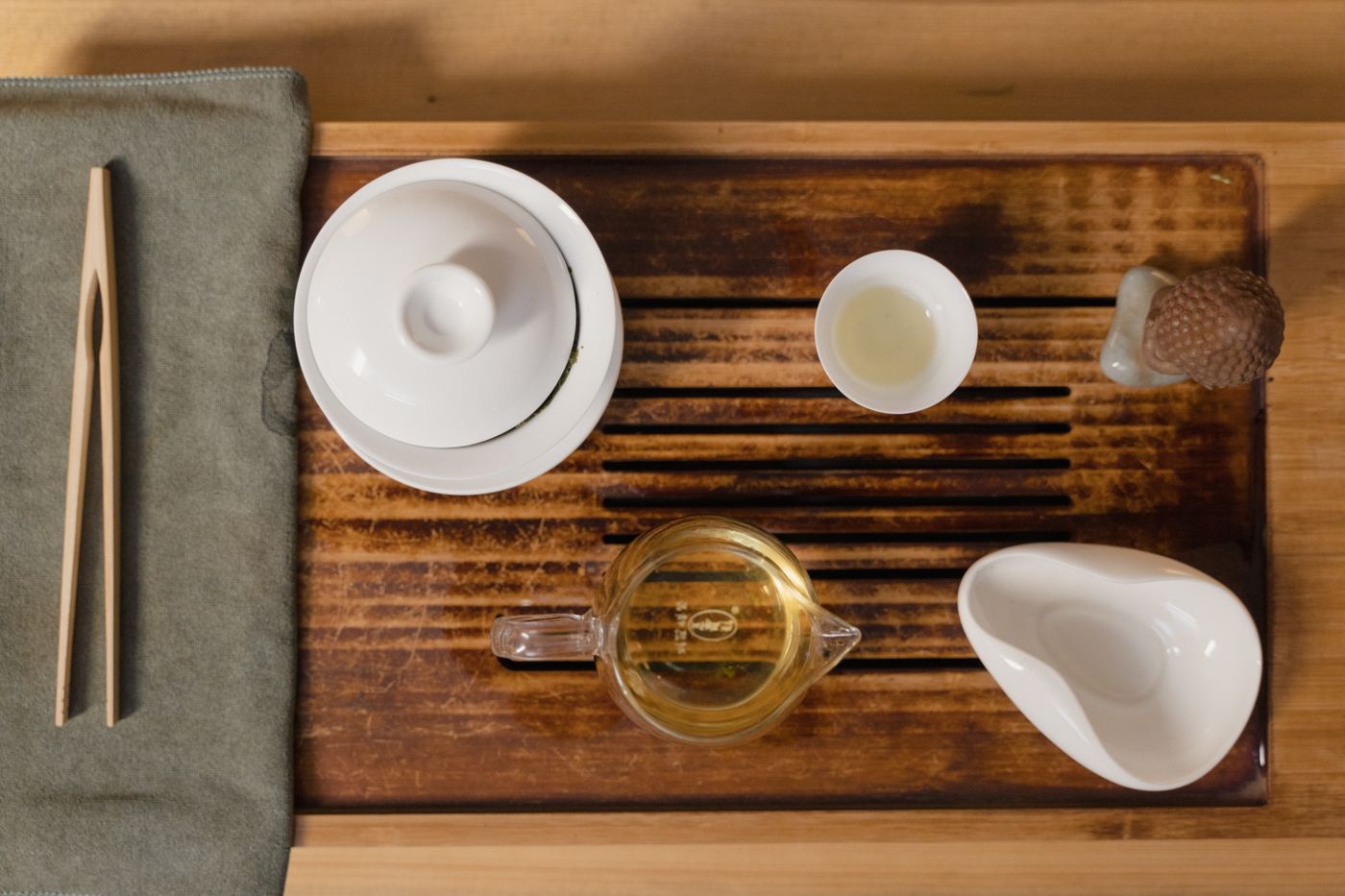
That is it. Gaiwan, pitcher, two cups. If somebody handed you only those four objects you could brew any Chinese tea properly for the rest of your life. Everything below is comfort, tidiness or theatre.
Every piece in a "full" set, and whether you need it
Here is what turns up in a boxed set, what each piece is for, and whether it earns its space.
| Piece | Chinese name | What it does | Verdict |
|---|---|---|---|
| Gaiwan | 蓋碗 gàiwǎn | Lidded bowl you brew in; the lid holds the leaves back as you pour | Essential |
| Fairness pitcher | 公道杯 gōngdàobēi | Decant here to stop the steep and even out the strength across cups | Essential |
| Tasting cups ×2–4 | 品茗杯 pǐnmíngbēi | 30–50 ml cups you actually drink from | Essential |
| Small teapot | 茶壺 cháhú | Brewing vessel; an alternative to the gaiwan, not an addition to it | Either/or |
| Kettle | 煮水壺 zhǔshuǐhú | Heats the water; a variable-temperature one saves guesswork with greens | Essential, but you own one |
| Digital scale | — | Weighs the leaf so your sessions repeat instead of drifting | Nice, and better value than most of this list |
| Tea tray | 茶盤 chápán | Catches spills and rinse water so you can pour freely over it | Nice, once spills annoy you |
| Strainer and stand | 茶漏 chálòu | Sits on the pitcher to catch fine broken leaf | Nice, if your tea is dusty |
| Tea cloth | 茶巾 chájīn | Wipes drips off the base of the pitcher before you pour | Nice; a kitchen cloth works |
| Six-gentlemen tool set | 茶道六君子 | Scoop, funnel, tongs, needle, pick and their pot | Skip at first |
| Aroma cup | 聞香杯 wénxiāngbēi | Tall cup you fill, decant, then smell the empty inside of | Skip unless you love the ritual |
| Tea pet | 茶寵 cháchǒng | Small clay animal you pour leftover tea over; it darkens over the years | Skip. Charming, does nothing |
| Tea boat | 茶船 cháchuán | Shallow dish the pot sits in during rinsing | Skip if you have a tray |
Count the essentials in that table and you get four lines, one of which is the kettle already in your kitchen. That is the argument in a nutshell.
Porcelain, clay or glass?
Material changes the tea more than shape does, and this is where a boxed set can quietly cost you.
| Material | How it behaves | Best for | The catch |
|---|---|---|---|
| Glazed porcelain | Non-porous and flavour-neutral; shows the liquor colour honestly | Every tea. Especially greens, whites and floral oolongs | None worth mentioning. This is the default |
| Unglazed Yixing clay | Porous; absorbs oils, softens high notes, thickens body, holds heat hard | Shou pu-erh, aged sheng, heavily roasted oolong | One pot per tea type, permanently. Also the most faked material in tea |
| Glass | Neutral, loses heat fastest, and you can watch the leaf open | Green tea, jasmine, anything pretty in the water | Cools quickly, chips easily, and gets cloudy if you neglect it |
| Glazed stoneware | Thicker walls, better heat retention than porcelain, still neutral inside | Black tea, pu-erh, cold rooms | Heavy, and often sold as "clay" at clay prices |

The clay question deserves a straight answer, because it is where enthusiasm outruns sense. Yixing ware is unglazed zisha clay from Jiangsu, fired so that the wall stays microscopically porous. Every brew leaves a trace behind. After a few hundred sessions the pot has taken on the character of whatever you have been putting through it, which is lovely if that is one tea and ruinous if it is nine. Brew a smoky shou in the morning and a delicate Biluochun at lunch, and the Biluochun will taste faintly of the morning.
Which means a clay pot is a commitment to a single tea type, made after you know which tea you drink most. Buying one as your first vessel is backwards, and buying six in a matching set is worse. Start with porcelain. It will never lie to you about what the tea is doing.
What size to buy
Bigger is not better here, and this is the mistake I see most. A gaiwan is held by its rim, and a large one filled with boiling water is genuinely hard to lift without spilling. It also demands more leaf per session for no extra pleasure.
| Drinkers | Gaiwan | Pitcher | Cups | Leaf per steep |
|---|---|---|---|---|
| One | 100 ml | 150 ml | 2 | 5–7 g |
| Two | 110–130 ml | 200 ml | 3 | 6–8 g |
| Three or four | 150 ml | 250–300 ml | 4–6 | 8–10 g |
| Five or more | Use a teapot instead | Not needed | Mugs are fine | 1 g per 100 ml |
Two details that matter more than the numbers. The rim should flare outward, because a flared rim stays cool enough to hold while the bowl is full. And the pitcher should hold at least as much as the gaiwan, ideally half again, or you will be stopping mid-pour. Ratios and timings for each tea type are laid out in our guide to gongfu brewing without the gatekeeping.
What to buy first, in order
- A plain porcelain gaiwan, 100 to 150 ml, flared rim. White inside. No painting where the tea goes, so you can read the colour.
- Two small cups. They do not have to match the gaiwan, and it looks better when they don't.
- A fairness pitcher. Glass is good here; you get to see the liquor before you pour it.
- A cheap digital scale. Unglamorous, and it improves your tea more than any pretty object on this page.
- A tray, whenever you get tired of wiping the table.
- A clay pot, once you know which single tea you drink most weeks. Not before.
Then stop. Tea pets, aroma cups and tongs are fine things to own if you enjoy them for their own sake, which is a perfectly good reason. Just do not buy them believing they will improve the cup, because they will not.
There is also a version of this where you buy none of it. If what you actually want is good tea at a desk for eight hours, a simple lidded cup or a double-wall glass bottle with room for the leaves to move does the job, and neither needs a ritual around it. There is no rule that says loose leaf requires ceremony.

Why the twenty-piece boxed set is a trap
Look at what you are paying for in a decorative boxed set. A lacquered case. A wooden tray. Six matching cups when you need two. A tool set most owners never take out of its holder. The money goes into the parts that sit still, and the two pieces that decide how your tea tastes, the brewing vessel and the pitcher, are usually the thinnest things in the box.
Size is the other problem. Boxed gaiwans tend to run 200 ml and up, because a big one looks generous in a product photo. That is the wrong size for one person and awkward in the hand. And when a cup breaks, which it will, the set stops matching and the whole aesthetic argument for buying it collapses.
My set is not a set. It is a plain white gaiwan I bought in a Hong Kong side-street shop because it fit my hand, a glass pitcher from a completely different place, and four cups that have nothing to do with each other, two of them survivors of things my grandmother owned. Nothing matches. It has brewed thousands of pots. The one time I was given a proper boxed set, the tray outlived my interest in it by about a decade, and I still use the gaiwan.
Buy the pieces separately, buy them plain, and spend what you save on better leaf. A plain porcelain gaiwan costs a fraction of a decorative set, and it is the piece that does the work.
FAQ
What is included in a Chinese tea set?
A traditional gongfu set includes a gaiwan or small teapot, a fairness pitcher, small tasting cups, a tray, a strainer, a tea cloth and a set of bamboo tools. Only the brewing vessel, the pitcher and two cups are genuinely necessary. The rest is convenience or decoration.
What size gaiwan should I buy?
Between 100 and 150 ml for one or two drinkers. That holds roughly 5 to 8 grams of leaf, which is a proper gongfu ratio, and it stays light enough to lift by the rim. Larger gaiwans are harder to pour and waste leaf when you brew alone.
Do I need a tea tray?
No. A tray catches rinse water and spills, which is pleasant but not required. A folded tea towel or a rimmed baking dish does the same job. Buy a tray when tidying up starts to irritate you, not as part of your first purchase.
Is porcelain or clay better for a Chinese tea set?
Porcelain for almost everyone. It is non-porous, so it stays neutral and brews any tea without carrying flavour over. Unglazed clay absorbs oils and suits one tea type only, which makes it a second or third purchase once you know what you drink most.
What is a fairness pitcher used for?
You pour the finished brew from the gaiwan into the pitcher, then serve from the pitcher. This stops the leaves steeping any further and makes every cup the same strength, instead of the first cup being weak and the last one bitter. It is the most useful piece after the gaiwan.
Hardware sorted? The part that actually decides how the cup tastes is the leaf in it. Our farm-direct Chinese teas are all sized to a 100 to 150 ml gaiwan, and every batch is lab-tested before it ships.